For other people of the same name, see Andrew Murray (disambiguation).
Andy Murray OBE

Murray at 2015 Australian Open
|
| Full name | Andrew Barron Murray |
|---|
| Country (sports) |  Great Britain Great Britain |
|---|
| Residence | London, England, UK |
|---|
| Born | 15 May 1987 (age 28)[1]
Glasgow,[2] Scotland, UK[3] |
|---|
| Height | 6 ft 3 in (1.91 m)[5][6][7][8][9] |
|---|
| Turned pro | 2005 |
|---|
| Plays | Right-handed (two-handed backhand) |
|---|
| Coach(es) | Leon Smith (1998–2005)
Mark Petchey (2005–2006)
Brad Gilbert (2006–2007)
Miles MacLagan (2007–2010)
Àlex Corretja (2010–2011)
Ivan Lendl (2011–2014)
Amélie Mauresmo (2014–)
Jonas Björkman (2015–) |
|---|
| Prize money |
$ 38,925,950[10]
- 5th all-time leader in earnings
|
|---|
| Official website | andymurray.com |
|---|
| Singles |
|---|
| Career record | 529–158 (77%)[11] |
|---|
| Career titles | 34 |
|---|
| Highest ranking | No. 2 (17 August 2009) |
|---|
| Current ranking | No. 3 (3 August 2015)[11] |
|---|
| Grand Slam Singles results |
|---|
| Australian Open | F (2010, 2011, 2013, 2015) |
|---|
| French Open | SF (2011, 2014, 2015) |
|---|
| Wimbledon | W (2013) |
|---|
| US Open | W (2012) |
|---|
| Other tournaments |
|---|
| Tour Finals | SF (2008, 2010, 2012) |
|---|
| Olympic Games |  Gold Medal (2012) Gold Medal (2012) |
|---|
| Doubles |
|---|
| Career record | 59–62 (48.76%) |
|---|
| Career titles | 2 |
|---|
| Highest ranking | No. 51 (17 October 2011) |
|---|
| Current ranking | No. 284 (20 July 2015) |
|---|
| Grand Slam Doubles results |
|---|
| Australian Open | 1R (2006) |
|---|
| French Open | 2R (2006) |
|---|
| Wimbledon | 1R (2005) |
|---|
| US Open | 2R (2008) |
|---|
| Other doubles tournaments |
|---|
| Olympic Games | 2R (2008) |
|---|
| Mixed doubles |
|---|
| Career record | 7–4 |
|---|
| Career titles | 0 |
|---|
| Grand Slam Mixed Doubles results |
|---|
| Wimbledon | 2R (2006) |
|---|
| Other mixed doubles tournaments |
|---|
| Olympic Games |  Silver Medal (2012) Silver Medal (2012) |
|---|
| Team competitions |
|---|
| Davis Cup | SF (2015) |
|---|
| Hopman Cup | F (2010) |
|---|
|
|
|---|
| Last updated on: 27 July 2015. |
Andrew Barron Murray OBE (born 15 May 1987) is a Scottish professional tennis player, currently ranked World No. 3.[10] He started playing tennis at the age of three, entered his first competitive tournament at age five and was playing league tennis by the time he was eight. He is known to be one of the most consistent players on the tour, having reached at least the quarter-finals of all Grand Slam Tournaments he has participated in since 2011.[12] When he was 15 he moved to Barcelona to train at the Sánchez-Casal Academy. He won the junior US Open in 2004 and turned professional the following year. Murray has been ranked as British No. 1 since 27 February 2006. He achieved a top-10 ranking by the ATP for the first time on 16 April 2007, and reached a career peak of world No. 2 on 17 August 2009.
Murray defeated Roger Federer at the 2012 Olympic Games in straight sets to win the gold medal in the men's singles final, becoming the first British singles champion in over 100 years. He also won a silver medal in the mixed doubles, playing with Laura Robson. At the 2012 US Open, Murray became the first British player since 1977, and the first British man since 1936, to win aGrand Slam singles tournament, when he defeated Novak Djokovic in five sets. This title made him the only British male to become a Grand Slam singles champion during the Open Era. On 7 July 2013, Murray won the 2013 Wimbledon Championships, becoming the first British player to win a Wimbledon singles title since Virginia Wade in 1977, and the first British man to win the Men's Singles Championship since Fred Perry, 77 years previously (not counting Laura Robson's 2008 junior singles title). He again beat Djokovic in the final, this time in straight sets. Murray is the only man in history to have won Olympic Gold and the US Open in the same calendar year, as well as only the third man to hold the Gold Medal and two majors on different surfaces (after Andre Agassi and Rafael Nadal). Subsequent to his success at the Olympics and Wimbledon, Murray was voted the 2013 BBC Sports Personality of the Year.
He has been the runner-up in six other singles Grand Slam finals: the 2008 US Open, the 2010, 2011, 2013 and 2015 Australian Open, and the 2012 Wimbledon Championships, losing three each to Roger Federer and Novak Djokovic. He is the first man in the open era to achieve four runner-up finishes at the Australian Open, after losing to Djokovic in the final of the 2015 Australian Open. In 2011, Murray became only the seventh player in the Open Era to reach the semifinals of all four Grand Slam tournaments in one year.[13] During the 2013 season he became the sixth man in tennis history to have won over $30 million in career prize money. After reaching the French Open semifinal in 2014 he became the tenth man to reach two or more semifinals at each of the four Majors.[14]
Contents
[hide]
- 1 Early and personal life
- 2 Career
- 2.1 Junior tennis
- 2.2 2005–2007: Reaching the top 15
- 2.3 2008: First major final and first Masters titles
- 2.4 2009: Reaching world rank No. 2
- 2.5 2010: Australian Open finalist and two Masters titles
- 2.6 2011: Second Australian Open final and two Masters titles
- 2.7 2012: US Open champion, Wimbledon runner-up and Olympic gold
- 2.8 2013: Wimbledon champion and third Australian Open final
- 2.9 2014: Recovery from surgery & 30th Career Title
- 2.10 2015: Fourth Australian Open final and first clay court titles
- 3 Rivalries
- 3.1 Murray vs. Djokovic
- 3.2 Murray vs. Federer
- 3.3 Murray vs. Nadal
- 4 Playing style
- 5 Endorsements and equipment
- 6 Charitable work
- 7 Image
- 7.1 National identity
- 7.2 Other
- 8 Career statistics
- 8.1 Grand Slam tournament performance timeline
- 8.2 Olympic Games
- 8.2.1 Finals: 2 (1 gold medal, 1 silver medal)
- 8.2.1.1 Singles: 1 (1–0)
- 8.2.1.2 Mixed Doubles: 1 (0–1)
- 8.3 Records
- 9 Awards and honours
- 10 See also
- 11 Notes
- 12 References
- 13 External links
Early and personal life[edit]
Murray was born to Judith (Erskine) and William Murray in Glasgow, Scotland.[3] His maternal grandfather, Roy Erskine, was a professional footballer in the late 1950s.[15] Murray's brother, Jamie, is also a professional tennis player, playing on the doubles circuit. Murray was born with a bipartite patella, where the kneecap remains as two separate bones instead of fusing together in early childhood,[16] but was not diagnosed until the age of 16. He is seen frequently to hold his knee due to the pain caused by the condition and has pulled out of events because of it.[17] Murray began playing tennis at the age of three when his mother Judy took him to play on the local courts.[18] He played in his first competitive tournament at age five and by the time he was eight he was competing with adults in the Central District Tennis League.[19]
Murray grew up in Dunblane and attended Dunblane Primary School. He and his brother were present during the 1996 Dunblane school massacre,[20] when Thomas Hamilton killed 16 children and a teacher before shooting himself; Murray took cover in a classroom.[21] Murray says he was too young to understand what was happening and is reluctant to talk about it in interviews, but in his autobiography "Hitting Back" he states that he attended a youth group run by Hamilton, and that his mother gave Hamilton lifts in her car.[22] Murray later attendedDunblane High School.[23][24]
Murray's parents split up when he was only 10.[25] He believes the impact this had on him could be the reason behind his competitive spirit.[26] At 15, he was asked to train withRangers Football Club at their School of Excellence, but declined, opting to focus on his tennis career instead.[27] He then decided to move to Barcelona, Spain. There he studied at the Schiller International School and trained on the clay courts of the Sánchez-Casal Academy. Murray described this time as "a big sacrifice".[24] His parents had to find £40,000 to pay for his 18-month stay there.[25] While in Spain, he trained with Emilio Sánchez, formerly the world No. 1 doubles player.[24]
In February 2013, Murray bought Cromlix House for £1.8 million which opened as a 15-room five-star hotel in April 2014.[28] Later that month Murray was awarded Freedom of Stirling and became a Doctor of the University of Stirling in recognition of his services to tennis.[29]
Murray began dating Kim Sears, daughter of player-turned-coach Nigel Sears, in 2005.[30][31] Their engagement was announced in November 2014,[31] and they married on 11 April 2015 at Dunblane Cathedral in his home town.[32] Sears is a pet portraitist and a former pupil of Burgess Hill School.[33]
Career[edit]

Andy Murray Singles Ranking History Chart 2003-2015
Junior tennis[edit]
Leon Smith, Murray's tennis coach from 11 to 17,[34] described Murray as "unbelievably competitive", while Murray attributes his abilities to the motivation gained from losing to his older brother Jamie. At the age of 12, Murray won his age group at the Orange Bowl, a prestigious event for junior players.[35]
In July 2003, Murray started out on the Challenger and Futures circuit. In his first tournament, he reached the quarterfinals of the Manchester challenger. In September, Murray won his first senior title by taking the Glasgow Futures event. He also reached the semi-finals of the Edinburgh Futures event.[36] In July 2004 Murray played a Challenger event in Nottingham, where he lost to future Grand Slam finalist Jo-Wilfried Tsonga in the second round. Murray then went on to win events in Xàtiva and Rome.
In September 2004, he won the Junior US Open and was selected for the Davis Cup match against Austria later that month;[37] however, he was not selected to play. Later that year, he won BBC Young Sports Personality of the Year.[38]
As a junior Murray reached as high as No. 6 in the world in 2003 (and No. 8 in doubles). In the 2004-instated combined rankings, Murray reached No. 2 in the world.[39]
Junior Slam results:
Australian Open: -
French Open: SF (2005)
Wimbledon: 3R (2004)
US Open: W (2004)
2005–2007: Reaching the top 15[edit]
Murray began 2005 ranked 407 in the world[40] and in March, he became the youngest Briton to play in the Davis Cup.[41] Murray turned professional in April and was given a wild card entry to a clay-court tournament in Barcelona, the Open SEAT, where he lost in three sets to Jan Hernych.[42] Murray then reached the semi-finals of the boys' French Open where he lost in straight sets to Marin Čilić.[43] Given a wild card to Queen's,[44] Murray progressed past Santiago Ventura in straight sets for his first ATP match win.[45] After a second round win against Taylor Dent,[46] he played former Australian Open champion Thomas Johansson in the third round, losing in three sets.[47][48] Following his performance at Queen's, Murray received a wild card for Wimbledon. Ranked 312, Murray became the first Scot in the Open Era to reach the third round of the men's singles tournament at Wimbledon.[49] In the third round, Murray lost to 2002 Wimbledon finalist David Nalbandian having led by two sets to love.[50]
Following Wimbledon, Murray won Challengers events on the hard courts of Aptos and Binghamton, New York. He then experienced his first Masters event at Cincinnati, where he beat Taylor Dent before losing in three sets to world No. 4 Marat Safin. With a wild card entry Murray played Andrei Pavel in the opening round of the US Open where he recovered from being down two sets to one to win his first five-set match.[51] He lost in the second round to Arnaud Clément in another five set contest.[52] Murray was again selected for the Davis Cup match against Switzerland. He was picked for the opening singles rubbers, losing in straight sets to Stanislas Wawrinka.[53] Murray then made his first ATP final at the Thailand Open where he faced world No. 1 Roger Federer. Murray lost in straight sets.[54] He completed the year ranked 64 and was named the 2005 BBC Scotland Sports Personality of the Year.[55]
The 2006 season saw Murray compete on the full circuit for the first time and split with his coach Mark Petchey[56] and team up with Brad Gilbert.[57] Murray suffered a straight sets defeat at the Australian Open, to Argentine Juan Ignacio Chela in the first round[58] and to Gaël Monfils at the French Open, in five sets.[59] Murray however reached the fourth round for the first time at both Wimbledon and the US Open.[60][61] Murray played in Davis Cup ties against Serbia, Israel and Ukraine. Murray missed the opening singles matches before losing the doubles as Britain lost their tie against Serbia.[62] During the tie with Israel, Murray won his rubber and lost the doubles before pulling out with a neck injury before the reverse singles.[63][64][65] Against the Ukraine, Murray won both his singles rubbers, but lost the doubles, as Britain won the tie.[66][67][68] At the Masters, Murray lost in the first round in Miami,[69] Monte Carlo and Rome.[70][71] Murray went out of the tournaments in Indian Wells and Hamburg in the second round.[72][73] Murray reached his first Masters semifinal in Toronto at the Rogers Cup losing to Richard Gasquet.[74]
In Cincinnati Murray became only one of two players, alongside Rafael Nadal, to defeat Roger Federer in 2006, breaking the Swiss star's 55 match winning streak on hard courts.[75] He lost two rounds later to Andy Roddick, but broke into the top 20 for the first time.[76][77] In the final two Masters events in Madrid and Paris, Murray exited both tournaments at the last-16 stage ending his season, with losses to Novak Djokovic and Dominik Hrbatý.[78][79] When the tour reached San Jose, California; Murray defeated a top ten player for the first time in the shape of Andy Roddick.[80] Murray went on to claim the SAP Open title defeating world No. 11 Lleyton Hewitt.[81] Murray was also a finalist at the Legg Mason Tennis Classic.[82] Playing doubles with his brother in Bangkok the pair reached the final.[83] After the French Open, where Murray was injured again, he revealed that his bones hadn't fully grown, causing him to suffer from cramps and back problems.[84]
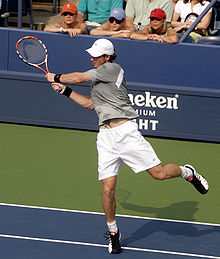
Murray on his way to becoming a finalist at the US Open
In November of the 2007 season Murray split with his coach Brad Gilbert and added a team of experts along with Miles Maclagan, his main coach.[85] Murray reached the fourth round of the Australian Open where he lost a five-set match against world No. 2 Rafael Nadal.[86] Murray however suffered a third round loss at the US Open. At the Masters tournaments Murray reached the semifinals of Indian Wells and Miami. At Rome and Cincinnati Murray exited in the first round whilst going out in the second in Canada. In the final two masters tournaments Murray exited in the third round in Madrid and he went out in the quarter finals of Paris. In his first match in Hamburg, Murray was up 5–1 when he hit a forehand from the back of the court and snapped the tendons in his wrist. Murray won titles in San Jose and St. Petersburg.[87] He also reached the final of tournaments in Doha and Metz finishing ranked 11th in the world.
2008: First major final and first Masters titles[edit]
In 2008, Murray suffered a first round loss at the Australian Open to eventual runner-up Jo-Wilfried Tsonga, and a third round loss at the French Open to Nicolás Almagro.[88] Murray then made his first Grand Slam quarter final at Wimbledon before making his first final at the US Open. During the tournament in New York, Murray claimed his first win over Nadal. That victory meant that he'd become the first player from Britain since Greg Rusedski in 1997 to reach a major final.[89] In his first Grand Slam final Murray suffered a straight sets loss to Federer.[90][91] At the Beijing Olympics, Murray suffered one of the worst defeats of his career, losing his first round singles match to world No. 77 Yen-hsun Lu of Taiwan in straight sets. That abject defeat was still on his mind in a BBC interview five years later – despite an intervening Olympic gold medal and a head-to-head win – when he met the same player (now ranked 75 in the world) in the 2nd round of Wimbledon 2013.[92]
In the Masters tournaments Murray went out in round four in Indian Wells and the first round of Miami. In the clay Masters Murray made the third round of Monte Carlo and Hamburg and the second of Rome. On the American hard court swing Murray made the semi finals of Toronto before winning his first Masters shield in Cincinnati. He added another shield to his collection in Madrid;[93] before losing in the quarter finals of Paris. Now at No. 4 in the world, Murray qualified for the first time for the Masters Cup. He played well in defeating an injured Federer[94] but lost to Davydenko in the semi-finals.[95] Murray ended 2008 ranked fourth in the world. Murray also won tournaments in Doha, Marseille and St Petersburg.
2009: Reaching world rank No. 2[edit]

Murray made the quarter-finals of the
2009 French Open
Murray opened the 2009 season with a successful defence of his title at the Qatar Open in Doha, defeating Andy Roddick in straight sets.[96] At the Australian Open, Murray made it to the fourth round, losing to Fernando Verdasco.[97] Murray won his eleventh career title inRotterdam, defeating No. 1, Nadal in the three sets.[98] Murray next went to Dubai but withdrew before the quarterfinals with a re-occurrence of a virus that had affected him at the Australian Open.[99] The virus caused Murray to miss a Davis Cup tie in Glasgow. Murray then lost in the finals to Nadal at Indian Wells,[100] but won a week later in Miami over Novak Djokovic for another masters title.
In the lead-up to the French Open, Murray lost to Nadal in the semis at the Monte Carlo Masters, he was upset in round two of the Rome Masters by qualifier Juan Mónaco, and he reached the quarterfinals of the Madrid Masters, losing to Del Potro. During this time Murray achieved the highest ever ranking of a British male in the Open Era when he became world No. 3 on 11 May 2009.[101] Murray reached the quarterfinals of the 2009 French Open, but was defeated by Fernando González in four sets.
Murray won for the first time on grass at Queen's and became the first British winner of the tournament since 1938. In the final Murray defeated American James Blake.[102] At Wimbledon, against Stanislas Wawrinka, Murray's fourth round match was the first match to be played entirely under Wimbledon's retractable roof, also enabling it to be the latest finishing match ever at Wimbledon.[103] However Murray lost a tight semifinal to Andy Roddick.
Murray returned to action in Montreal, defeating del Potro in three sets to take the title.[104] After this victory, he overtook Nadal in the rankings and held the number two position until the start of the US Open.[105] Murray followed the Masters win playing at the Cincinnati Masters, where he lost to Federer. At the US Open, Murray was hampered by a wrist injury and suffered a straight-sets loss to Čilić.[106] Murray won both his singles matches, and lost at doubles in the Davis Cup against Poland, but was then forced to miss six weeks with a wrist injury.[107]
In November, Murray won at Valencia,[108] but bowed out in round two of the Paris Masters. To end the season, Murray did not make it out of the round robin at the World Tour Finals in London.[109]
I can cry like Roger, it's a shame I can't play like him.
“
”
Andy Murray during his runner's up speech at the 2010 Australian Open.[110]
2010: Australian Open finalist and two Masters titles[edit]
Murray and Laura Robson represented Britain at the Hopman Cup. The pair progressed to the final, where they were beaten by Spain.[111] At the Australian Open Murray beat Nadal and Cilic before losing in the final to world No. 1 Roger Federer.[112] At the BNP Paribas Open in Indian Wells, Murray reached the quarterfinals, losing to Robin Söderling in straight sets. Murray next played at the2010 Sony Ericsson Open, but lost his first match of the tournament, afterwards saying that his mind hadn't been fully on tennis.[113] At Monte-Carlo Rolex Masters Murray suffered another first match loss, this time to Philipp Kohlschreiber. He also entered the doubles competition with Ross Hutchins but lost to the Bryan Brothers on a champions tie-breaker. Murray reached the third round in the Rome Masters, and the quarterfinals at the Madrid Masters, losing both times to David Ferrer.

Murray reached his second Grand Slam Final in Australia.
After playing an exhibition match Murray started the French Open with three tough wins before losing in straight sets to Tomáš Berdych in the fourth round[114] In London Murray progressed to the third round, where he faced Mardy Fish. At 3–3 in the final set with momentum going Murray's way (Murray had just come back from 3–0 down), the match was called off for bad light, leaving Murray fuming. Coming back the next day, Murray was edged out by the eventual finalist in a tie-breaker for his second defeat by him in the year.[115][116] At Wimbledon Murray progressed to the semi-finals, losing to Rafael Nadal in straight sets.[117] On 27 July 2010, Andy Murray and his coach Maclagan split, and Murray replaced him with Àlex Corretja.[118]
Starting the US hard-court season with the 2010 Farmers Classic, Murray reached the final but lost against Sam Querrey in three sets. This was his first loss to Querrey in five career meetings.[119] In Canada, Murray became the first player since Andre Agassi in 1995 to defend the Canadian Masters. Murray defeated Nadal and then Federer in straight sets, ending his eight-month title drought.[120] At theCincinnati Masters, Murray first complained about the speed of the court,[121] and then in a quarterfinal match with Fish, Murray complained that the organisers refused to put the match on later in the day[122] With temperatures reaching 33 °C in the shade, Murray won the first set in a tie-breaker but began to feel ill. The doctor was called on court to actively cool Murray down. Murray admitted after the match that he had considered retiring. He lost the second set, but forced a final-set tie-breaker, before Fish won.[123] After losing to Stanislas Wawrinka in the third round of the US Open, questions about Murray's conditioning arose, as he called the trainer out twice during the match.[124]
His next event was the China Open in Beijing, where Murray reached the quarterfinals, losing to Ivan Ljubičić.[125] Murray then won the Shanghai Rolex Masters dismissing Roger Federer in straight sets.[126] He did not drop a single set throughout the event. Murray returned to Spain to defend his title at the Valencia Open 500 but lost in the second round to Juan Mónaco.[127] However, in doubles, Murray partnered his brother Jamie Murray to the final, where they defeated Mahesh Bhupathi and Max Mirnyi. The victory was Murray's first doubles title and the second time he had reached a final with his brother.[128]
Murray reached the quarter finals at the BNP Paribas Masters losing to Gaël Monfils in three sets. Combined with his exit and Söderling's taking the title, Murray found himself pushed down a spot in the rankings, to No. 5 from No. 4.[129] At the Tour finals in London, Murray went 2–1 in round robin play before facing Nadal in the semifinal. They battled for over three hours, before Murray fell to the Spaniard in a final-set tie-breaker, bringing an end to his season.[130]
2011: Second Australian Open final and two Masters titles[edit]
Murray and fellow Brit Laura Robson lost in the round-robin stage 2011 Hopman Cup, losing all three ties even though Murray won all of his singles matches. Then Murray, along with other stars such as Roger Federer, Rafael Nadal, and Novak Djokovic, participated in the Rally for Relief event to help raise money for the flood victims in Queensland.[131]

Andy with his brother
Jamie (left) at the 2011 Japan Open
Seeded fifth in the 2011 Australian Open, Murray met former champion Novak Djokovic in the final and was defeated in straight sets. InRotterdam, he was defeated by Marcos Baghdatis in the first round.[132] Murray reached the semifinals of the doubles tournament with his brother Jamie. Murray lost to qualifiers in the first rounds at the Masters Series events in Indian Wells and Miami, after which he split with coach Àlex Corretja.[133]
Murray returned to form at the Monte-Carlo Rolex Masters, but lost to Nadal in the semifinals.[134] Murray sustained an elbow injury before the match and subsequently withdrew from the 2011 Barcelona Open Banco Sabadell due to the injury.[135] Murray lost in the third round at the Mutua Madrileña Madrid Open, but made it to the semifinals of the Rome Masters, where he lost to Novak Djokovic.[136] At the French Open, Murray won two tough early matches, before losing in his first semifinal at Roland Garros, against Rafael Nadal.[137][138][139]
Murray defeated Jo-Wilfried Tsonga to win his second Queen's Club title.[140] At Wimbledon, Murray lost in the semifinal to Nadal, despite taking the first set.[141] At the Davis Cup tie between Great Britain and Luxembourg, Murray led the British team to victory.[142] Murray was the two-time defending 2011 Rogers Cup champion, but lost in the second round to South African Kevin Anderson.[143] However, the following week, he won the 2011 Western & Southern Open, beating Novak Djokovic, after Djokovic retired due to injury.[144] At the 2011 US Open, Murray battled from two sets down to win a five-set second-round encounter with Robin Haase, but lost in the semifinals to Rafael Nadal in four sets.
Murray easily won the small 250-class Thailand Open, and the following week he won his third title in four tournaments at the Rakuten Japan Open Tennis Championships. His opponent in the final was Rafael Nadal, whom he beat for the first time in the year in three sets. Murray then won the doubles with his brother Jamie Murray, becoming the first person in the 2011 season to capture both singles and doubles titles at the same tournament. Murray then successfully defended his Shanghai Masters crown with a straight-sets victory over David Ferrer in the final. At the ATP World Tour Finals, Murray lost to David Ferrer in straight sets and withdrew from the tournament after the loss with a groin pull. Murray ended the year as No. 4 in the world behind Novak Djokovic, Rafael Nadal, and Roger Federer.
2012: US Open champion, Wimbledon runner-up and Olympic gold[edit]
Main article: 2012 Andy Murray tennis season
With Ivan Lendl as his new full-time coach,[145] Murray began the season by playing in the 2012 Brisbane International. He overcame a slow start in his first two matches to win his 22nd title by beating Alexandr Dolgopolov in the final.[146] In doubles, he lost in the quarterfinals against second seeds Jürgen Melzer and Philipp Petzschner in a tight match.[147] After an exhibition tournament,[148] Murray made it to the semifinals of the 2012 Australian Open, where he was defeated by Djokovic in a four-hour-and 50-minute match.[149]

Murray's victory signature at the Olympics where he won the gold medal.
At the Dubai Duty Free Tennis Championships, Murray defeated Djokovic in the semifinals, but lost in the final to Roger Federer.[150] After an early defeat at the BNP Paribas Open, Murray made the finals of the Miami Masters, losing to Djokovic.[151] Murray then had quarterfinal losses at the Monte Carlo Masters and Barcelona Open, and a third round loss at the Italian Open.[151] Murray battled back spasms all through the French Open, and in the quarterfinals he was beaten by David Ferrer.[152]
Murray lost in the opening round of the Queen's Club Championships to world No. 65 Nicolas Mahut.[153] At Wimbledon, Murray set the record for the latest finish at the championships when he completed a four-set victory over Marcos Baghdatis at 23:02 BST.[154] Murray beat Jo-Wilfried Tsonga in the semifinal in four sets to become the first male British player to reach the final of Wimbledon since Bunny Austin in 1938.[155] In the final, he faced Federer, but after taking the first set, he lost the match in four sets.[156]
Murray next competed at the London 2012 Summer Olympics in singles, doubles, and mixed doubles. He partnered his brother Jamie Murray in doubles and suffered a first-round exit to Austria (Jürgen Melzer and Alexander Peya) in three sets.[157] In the mixed doubles, Murray was partnered by Laura Robson. They made it all the way to the finals where they lost to the Belarusian top seeds (Victoria Azarenka and Max Mirnyi) in three sets, settling for the silver medal. In singles, Murray lost only one set and 39 games on his way to the finals where he met Federer, defeating him in straight sets, for the loss of just 7 games.[151] By winning the Olympic gold medal, Murray became the first British man to win the Olympic singles gold medal in tennis since Josiah Ritchie in 1908, and only the 7th man in the open era to win two medals at the same Olympic Games.[158]
Murray retired early in the Rogers Cup due to a knee injury, and was beaten by unseeded Jérémy Chardy at the Cincinnati Masters in straight sets. He next competed in the final major of the season at the US Open. He cruised through his opening two rounds in straight sets against Alex Bogomolov and Ivan Dodig, before facing a tough four-set battle withFeliciano López, where Murray had to win three tie-breakers. In the fourth round, he defeated the Canadian Milos Raonic in straight sets, and then in the quarterfinals, had to come from a set and two breaks down against Marin Čilić to prevail in four. In the semifinals, he defeated Tomáš Berdych in a long-fought match that lasted almost four hours, to reach his second consecutive Grand Slam final. Murray defeated Djokovic in five sets, becoming the first British man to win a Grand Slam final since Fred Perry in 1936[159] and the first Scottish-born player to win a Grand Slam final since Harold Mahony in 1896.[160] The win would also set several records for Murray: it involved the longest tiebreak in US Open final history at 12–10 in the first set, it made Murray the first man ever to win an Olympic gold medal and the US Open in the same year, and it tied with the 1988 US Open final (in which Murray's coach Lendl competed) as the longest final in the tournament's history.[161] By defeating Djokovic in the final, Murray achieved his 100th Grand Slam match win of his career. The victory made Murray part of the "Big Four" according to many pundits, including Novak Djokovic.[162][163]

Andy Murray with coach Ivan Lendl
In his first tournament after the US Open, Murray reached the semifinals of the Rakuten Japan Open after entering as defending champion. He was beaten by Milos Raonic in a close three-set match. He was also defending champion in the doubles with his brotherJamie. However, they were knocked out in the quarterfinals by top seeds Leander Paes and Radek Štěpánek. At the penultimate Masters 1000 tournament of the year in Shanghai, after receiving a bye into round two, Murray's first match was due to be played against Florian Mayer. However, Mayer had to pull out due to injury, giving Murray a walkover into round three. After beating Alexandr Dolgopolov in the third round, he then overcame Radek Štěpánek in a three-set quarterfinal. Murray next faced Roger Federer in the semifinals, whom he defeated in straight sets to set up a second consecutive final against Novak Djokovic, and his third consecutive Shanghai final. After failing to capitalise on five match points, Murray eventually lost in three sets, bringing to an end his 12–0 winning streak at the competition.
When Rafael Nadal pulled out of both the Paris Masters and the Year-End Championships,[164] Murray finished the year at No. 3 in the world, after four years at No. 4. This was the first time Murray had finished the year higher than No. 4 in the world. At the BBC Sports Personality of the Year Murray found himself voted third overall, ahead of Mo Farah.[165] Murray won the World Breakthrough of the Year at the Laureus World Sports Awards.[166]
Murray was appointed Officer of the Order of the British Empire (OBE) in the 2013 New Year Honours for services to tennis.[167][168][169]
2013: Wimbledon champion and third Australian Open final[edit]
Main article: 2013 Andy Murray tennis season
"I'd like to dedicate this victory to one of my best friends. He's back home watching – you're going to get through it."
Murray dedicated his Brisbane International win to Ross Hutchins.[170][171]
Murray began his 2013 season by retaining his Brisbane International title, defeating Grigor Dimitrov in the final in straight sets.[170]Trying to win his second Major in a row, he began the 2013 Australian Open well with a straight sets victory over Dutchman Robin Haase. He followed this up with straight set victories over João Sousa, practice partner Ričardas Berankis and French No. 14 seedGilles Simon. In the quarterfinals he cruised past Jérémy Chardy in straight sets to set up a semi final clash with Roger Federer. After exchanging sets, Murray eventually prevailed in 5 sets, recording his first Grand Slam tournament triumph over Federer. With this victory, each member of the ATP's most dominant quartet of the previous four years (Federer, Nadal, Djokovic and Murray) had beaten the other three at the Majors.[172] This victory set up Murray's third consecutive Major final appearance, and second in a row againstNovak Djokovic. After taking the first set in a tiebreak, Murray was eventually defeated in four sets.[173] His defeat in this final meant that Murray became only the second man in the Open Era to achieve three runner-up finishes at the Australian Open, the other being Stefan Edberg.
At the BNP Paribas Open in Indian Wells, Murray lost at the quarter-final stage to Juan Martín del Potro in three sets.[174] At the Miami Masters, Murray made it through his first four matches without dropping a set, and after overcoming Richard Gasquet in the semifinals, faced David Ferrer in the final. After losing the first set, and facing match point in the decider at 5–6, Murray eventually took the match in a third set tiebreaker to win his second Miami Masters title, and leapfrog Roger Federer into second place in the rankings, ending a near-decade long time period in which neither Federer or Rafael Nadal were ranked in the top two.[175] Murray briefly fell back to number 3 in the world, following a third round defeat by Stanislas Wawrinka in Monte-Carlo, but reclaimed the number 2 ranking as a result of Federer failing to defend his title at the Mutua Madrid Open. Later, Murray lost at the quarter-final stage to Tomáš Berdych in straight sets.[176] On 15 May 2013 at the Rome Masters, Murray retired due to a hip injury during his second round match against Marcel Granollers on his 26th birthday. Murray had just battled back to tie the match at one set all after winning the second set on a tiebreak. This left Murray with only eleven days to be fit for the start of the French Open.[177]
Speaking at a press conference after the match, Murray said, "As it is, I'd be very surprised if I was playing in Paris. I need to make a plan as to what I do. I'll chat with the guys tonight and make a plan for the next few days then make a decision on Paris after the next five days."[178] He would go on to withdraw from Roland Garros later, citing a back injury.[179] After a four-week break due to injury, Murray made his comeback at the 2013 Aegon Championships, where he was the top seed. After a rain delayed first day, Murray had to complete his second round match against Nicolas Mahut, and his subsequent match against Marinko Matosevic on the same day, both of which he won in straight sets. After beating Benjamin Becker in the quarterfinals, Murray next faced his first top ten opponent since losing to Tomas Berdych in Madrid, taking on Jo-Wilfried Tsonga in the semifinals. After dropping the first set against the Frenchman, Murray eventually raised his level and won in three to set up a final against Marin Čilić of Croatia, his third consecutive final on grass courts. He came from behind again to beat Čilić in three sets to claim his third title at Queen's Club.[180]
Going into Wimbledon, Murray hadn't lost a match on grass since the previous year's final, and was on a winning streak of 11 matches on grass. In the first two rounds, Murray faced Benjamin Becker[181] and Yen-hsun Lu[182] respectively, defeating both in straight sets. His third round match was against 32nd seed Tommy Robredo, and despite a tour comeback over the past year, Murray overcame the Spaniard in straight sets to set up a clash with Mikhail Youzhny, the highest seed left in Murray's half following the unexpectedly early exits of Roger Federer and Rafael Nadal.[183] Despite facing a fightback in the second set, Murray won in straight sets to make it through to his tenth consecutive Grand Slam quarterfinal,[184] in which he was to play Fernando Verdasco, the first left-handed player Murray had faced since the 2012 US Open. For the seventh time in his career, Murray had to come back from a deficit of two sets to ultimately come through in five,[185] setting up a semifinal clash with 24th seed Jerzy Janowicz, the Polish player who beat Murray in their previous encounter. After Murray failed to break Janowicz's serve, the Pole took the opening set in the tiebreak, following a double fault from Murray. However Murray managed to up his level of play, and won the next three sets, making it through to his second consecutive Wimbledon final, and third consecutive major final against Novak Djokovic.[186]

Murray holds the Wimbledon trophy following his victory in the
2013 men's final.
Despite the Serb being the favourite to win the title throughout the Championships, Murray overcame Djokovic in a straight sets match that lasted over three hours, to become the first British winner of the men's singles title since Fred Perry in 1936, the first Scot of either sex to win a Wimbledon singles title since Harold Mahoney in 1896, and to extend his winning streak on grass to 18 matches.[187] With the win, he also became only the second man in the open era after Rafael Nadal to hold the Olympic singles gold medal and Wimbledon title simultaneously.
At the US Open, Murray entered a Grand Slam tournament as defending champion for the first time, and started strongly with a straight sets win against Michael Llodra. He backed this up with wins over Leonardo Mayer, Florian Mayer and Denis Istomin to reach the quarterfinals at a major for the 11th straight tournament. In the last 8, Murray faced Stanislas Wawrinka of Switzerland, but lost in straight sets, ending Murray's streak of four consecutive major finals.[188] Following his disappointing run of form on hard courts, Murray next joined the Great Britain Davis Cup team in their World Group Play-off tie on clay against Croatia, where he played in two singles and the doubles rubbers. After defeating 16-year-old Borna Ćorić in straight sets, Murray teamed up with Colin Fleming to defeat Croatian number 1 Ivan Dodig and Mate Pavić in the doubles, and take a 2–1 lead in the tie. Murray then sealed Britain's return to the World Group by defeating Dodig in straight sets.
Following the Davis Cup, Murray's season was cut short by his decision to undergo surgery, in order to sort out the lower back problems that had caused him problems since the early stages of the previous season. After being forced to withdraw from the French Open in May, the injury flared up again during the US Open and later during the Davis Cup World Group Play-offs, Murray made the decision that surgery was the best way to sort the problem out for the long-term.[189] Following the conclusion of the 2013 season, Murray was voted the 2013 BBC Sport Personality of the Year, after having been heavy favourite since the nominees were announced.[190]
2014: Recovery from surgery & 30th Career Title[edit]
Main article: 2014 Andy Murray tennis season
Murray started his season at the Qatar Open in Doha. In the first round, he defeated Mousa Shanan Zayed in straight sets in 37 minutes without dropping a single game, but was defeated in three sets by world number 40 Florian Mayer in the second round, despite being a set and a break up three games into the second set.[191] He then played a warm-up match at the 2014 AAMI Classic in Kooyong against world No. 43 Lleyton Hewitt, losing in two close tiebreaks. Murray next headed to Melbourne for the 2014 Australian Open, where he drew world number 112 Go Soedaof Japan. Despite worries that he was not match-fit, Murray got off to a strong start, dispatching the Japanese number 2 in under 90 minutes, losing just 5 games in the process. He next went on to defeat Vincent Millot and Feliciano Lopez respectively in straight sets. In the fourth round, Murray dropped his first set of the tournament on his way to beating Stephane Robert in four sets to set up a meeting with long-standing rival Roger Federer in the quarterfinals. Despite saving two match points to take the third set, he ultimately went out in four, ending his streak of four consecutive Australian Open semifinals.[192] As a result of losing before the final, Murray fell to number 6 in the world, falling out of the top 5 for the first time since 2008.
He next headed to the United States to compete in the Davis Cup first round with Great Britain, who went into the tie as outsiders. Murray won both of his ties against Donald Young and Sam Querrey respectively, helping Britain to their first Davis Cup quarterfinal since 1986.[193] Murray's next tournament was the Rotterdam Open after receiving a late wild card, however he lost to Marin Cilic in straight sets in the quarterfinals. His following competition, the Mexican Open in Acapulco, ended in a semifinal defeat by Grigor Dimitrov in a thrilling three sets that required two tiebreakers to decide the final two sets. At Indian Wells, Murray struggled in his first two matches against Lukáš Rosol and Jiří Veselý respectively, overcoming both in close three-set encounters to set up a fourth round clash with Canadian Milos Raonic, which he lost in three sets. In March, Murray split with coach Ivan Lendl, who had been widely praised for helping Murray achieve his goal of winning Grand Slam titles.[194] At the 2014 Miami Masters, Murray defeated Matthew Ebden, Feliciano Lopez and Jo Wilfried Tsonga but lost to Novak Djokovic in the quarterfinals. In the Davis Cup quarterfinals against Italy, he beat Andreas Seppi in his first rubber, then teamed up with Colin Fleming to win the doubles rubber, but in his final singles match, was stunned by Fabio Fognini in straight sets, which took Great Britain to the deciding final rubber. However, in this match his compatriot, James Ward was defeated by Andreas Seppi, also in straight sets, knocking Murray and Great Britain out of the Davis Cup.
Murray next competed at the Madrid Open and following his opening win, over Nicolas Almagro, he dedicated the victory to former player Elena Baltacha.[195][196] He then lost to qualifier Santiago Giraldo in the following round. Murray then reached the quarter-finals of the Rome Masters where he lost to world number one Rafael Nadal in a tight match in which he had been up a break in the final set.[197] At the French Open, Murray defeated Andrey Golubev and Marinko Matosevic before edging out 28th seed Philipp Kohlschreiber 12–10 in the final set. This was the first time Murray had ever gone beyond 7–5 in a deciding set.[198] He followed this up with a straight sets win over Fernando Verdasco and then recorded a five set victory over Frenchman Gaël Monfils in the quarter-final, which saw Murray rise to world No. 5 and equal his best ever French Open by reaching the semi-finals. However, he subsequently lost to Rafael Nadal in straight sets, winning only 6 games in the match.[199] After losing the 2014 French Open semi-finals to Nadal, Murray appointed former women's world number one, and two-times slam titlist, Amelie Mauresmo as his coach[200] in a 'historic move' which made Mauresmo the first woman to coach a top male tennis player.[201]
After strong grass court seasons in 2012 and 2013, Murray was seeded third for the 2014 Wimbledon Championship, behind Novak Djokovic and Rafael Nadal, who were seeded first and second respectively.[202] He began his title defence with straight sets wins over David Goffin[203] and Blaž Rola, defeating the latter for the loss of just two games.[204]Murray continued his good form, defeating Roberto Bautista Agut[205] and Kevin Anderson,[206] the 27th and 20th seeds, again in straight sets to reach his seventh consecutive Wimbledon quarterfinal. Murray's defence then came to a halt as Grigor Dimitrov ended his 17 match winning-streak on the grass of Wimbledon (this includes the 2012 Olympics) with a straight sets win, meaning Murray failed to reach the semi-finals for the first time since 2008.[207] After his defeat at the Championships, Murray dropped to 10th in the world, his lowest ranking since 2008.[208]
Prior to the North American hard court swing, Murray announced he was extending his partnership with Amélie Mauresmo until the end of the US Open, but was ideally looking for a long-term deal.[209] He also revealed he had only just returned to a full training schedule following his back surgery last September.[210] Murray reached back-to-back quarter-finals at the Canadian Open and Cincinnati Masters, losing to eventual champions Jo Wilfried Tsonga,[211] after being a break up in the decider,[212] and Roger Federer, after being two breaks up in the second set, respectively.[213] He then made it to the quarterfinals of the 2014 US Open, losing to Novak Djokovic, after earning his first top ten win of the year in the previous round against Jo Wilfried Tsonga.[214] This was the first season since 2009 where Murray failed to reach a grand slam final. As a consequence Murray fell outside of the top 10 ranking places for the first time since June 2008.[215]
Murray took a wildcard into the inaugural Shenzhen Open in China, entering as the number 2 seed. Victories over Somdev Devvarman, Lukáš Lacko and Juan Mónaco saw Murray reach his first final of the season, breaking a drought of 14 months following his title at Wimbledon. In the final he faced Tommy Robredo of Spain, the second final between the two. After saving five championship points in the second set tie break, Murray went on to win the title in three sets, Robredo's drop in fitness ultimately proving decisive.[216] He then took his good form into Beijing, where he reached the semifinals before losing to Djokovic in straight sets,[217] however he lost in the third round at theShanghai Masters to David Ferrer despite being a set up.[218] Following his early exit in Shanghai, Murray took a wildcard into the Vienna Open in an attempt to claim a place at the ATP World Tour Finals. He reached the final, where he once again faced Ferrer, and triumphed in three sets for his second title of the season, and the 30th of his career.[219]Murray defeated Ferrer again in the semi-finals of the Valencia Open to move into his third final in five weeks, and further strengthen his bid for a place at the season finale in London.[220] In a repeat of the Shenzhen Open final, Murray again saved five championship points as he overcame Tommy Robredo in three sets.[221] Murray then went on to reach the quarter-finals of the Paris Masters, where he was eliminated by Djokovic in what was his 23rd match in the space of only 37 days.[222] However, his win over Dimitrov in the third round had already guaranteed him a spot at the ATP World Tour Finals.[223]
At the ATP World Tour Finals, Murray lost his opening round robin match to Kei Nishikori[224] but won his second match against Milos Raonic.[225] However, he lost his final group match against Federer in straight sets and only managed to win one game against him, marking his worst defeat since losing to Djokovic in the 2007 Miami Masters, eliminating him from the tournament.[226] Despite the loss, his late-season run had already propelled him back up the rankings to number 6 in the world, his best ranking since June.
Following the conclusion of the season, Murray mutually agreed a split with long-term backroom staff, training partner Dani Vallverdu and fitness coach Jez Green. They had been with him for five and seven years respectively but were both reported to have been unhappy at the lack of consultation they had been given about the appointment of Mauresmo.[227] Murray also took part in the inaugural season of the International Premier Tennis League, representing the Manila Mavericks, who had drafted him as an icon player in February.[228] Murray took part in the first three matches of the tournament which were all played in Manila.[229]
2015: Fourth Australian Open final and first clay court titles[edit]

Murray at the 2015 Australian Open
Main article: 2015 Andy Murray tennis season
Murray began his year by winning an exhibition event in Abu Dhabi.[230] He then played the Hopman Cup with Heather Watson and, despite winning all his singles matches in straight sets, they finished second in their group behind Poland.[231] His first competitive tournament of the year was the Australian Open. He won his opening three matches in straight sets before defeating 11th seed Grigor Dimitrov to reach the quarter-final.[232] Wins over Nick Kyrgios[233] and Tomáš Berdych followed as Murray reached his fourth final at the tournament (three of which were against Djokovic) and the eighth grand slam final of his career.[234] He lost the final to Novak Djokovic in four sets,[235] however his run to the final saw his return to the top four in the world rankings for the first time in 12 months.[236] Murray next participated in theRotterdam Open as the top seed, but he lost in the quarterfinals to Gilles Simon who ended a 12 match losing streak against Murray.[237]Murray then played in the Dubai Championships but suffered another quarterfinal defeat to 18-year-old Borna Ćorić and as a result, Murray slipped to no. 5 in the world rankings behind Rafael Nadal and Kei Nishikori.[238][239] Afterwards, Murray played the Davis Cup World Groupin Glasgow against the United States. He won both his matches against Donald Young and John Isner, allowing Great Britain to progress to the quarterfinals for the second consecutive time with a 3–2 lead over the United States.[240]

Murray with new coach Jonas Björkman during practice at the 2015
Aegon Championships.
Murray then reached the semifinals of the 2015 Indian Wells, overtaking Tim Henman's record of 496 career wins to have the most career wins for a British man in the Open Era.[241] However, he suffered a 6th consecutive defeat to Djokovic in straight sets.[242] Murray then reached the final of the2015 Miami Open, recording his 500th career win along the way to become the first British player to have 500 or more wins in the Open Era.[243] He went on to lose the final to Djokovic, this time in three sets.[244] Murray added Jonas Björkman to his coaching staff in March initially on a five-week trail to help out in periods when Mauresmo was unavailable as she only agreed to work with him for 25 weeks.[245] However, at the end of the Australian Open, Mauresmo had informed Murray that she was pregnant and he announced at the end of April, that Björkman would be his main coach for all of the grass court season and all of the US hard court swing, while Mauresmo would only be with the team for Wimbledon.[246]
Murray won his first ATP clay court title at the 2015 BMW Open. He defeated German Philipp Kohlschreiber in three close sets to become the first Briton since Buster Mottram in 1976 to win a tour level clay court event.[247][248] The following week he reached his second final on clay, at the Madrid Open after recording only his second and third victories over top 10 opposition on clay, against Raonic and Nishikori.[249][250] In the final, he defeated Rafael Nadal in straight sets for his first Madrid title on clay, and first ever clay court Masters 1000 title. The win was Murray's first over Nadal, Federer or Djokovic since Wimbledon 2013, and his first over Nadal on a clay court.[251][252] Murray continued his winning streak at theItalian Open, beating Jeremy Chardy in straight sets in his opening match, but then withdrew due to fatigue after having played nine matches in the space of 10 days. Murray then reached his third semifinal at the French Open, but lost to Djokovic in five sets after threatening a comeback from two sets to love down, ending his 15 match winning streak on clay.[253] To start his grass court campaign, Murray went on to win a record tying fourth Queen's Club title, defeating the big serving South African Kevin Anderson in straight sets in the final.[254] At the third grand slam of the year, the 2015 Wimbledon Championships, Murray dropped only two sets on his way to setting up a semifinal clash with Roger Federer. Many people saw Murray as the slight favourite, however he lost to the Swiss veteran in straight sets, only creating one break point in the entire match.
After Wimbledon, Murray returned to Queen's Club, to play for Great Britain against France in their Davis Cup quarterfinal tie. Great Britain went 1–0 down when James Ward lost to Gilles Simon in straight sets, however Murray levelled the tie with a victory against Jo-Wilfried Tsonga. Murray then teamed up with his brother Jamie to win the doubles rubber, coming back from a set down to defeat Tsonga and Nicolas Mahut in four sets, and giving Britain a crucial 2–1 lead going into the final day. He then faced Simon in the fourth rubber and after initially being a set and a break down, he suddenly found his form again towards the end of the second set and eventually won in four sets, winning 12 of the last 15 games in the process (with Simon struggling from an ankle injury). With a 3–1 lead over France, this resulted in Great Britain reaching their first Davis Cup semifinal since 1981.
After his Davis Cup heroics, Murray next participated at the Citi Open (for the first time since 2006), as the top seed and favourite to win the tournament. However, he suffered one of the worst defeats of his career in his first match, losing to world No. 53 Teymuraz Gabashvili in a final set tiebreak, despite serving for the match and getting two points away from victory late in the third set, before getting broken. Despite the loss, Murray said that it was his first hard court match in over four months, with only four or five days of preparation, and he was happy with how he moved and did certain things on the court.
Rivalries[edit]
See also: Big Four (tennis)
Murray vs. Djokovic[edit]
Main article: Djokovic–Murray rivalry
Novak Djokovic and Andy Murray have met 27 times with Djokovic leading 19–8.[255][256] Djokovic leads 3–0 on clay, 16–6 on hard courts, and Murray leads 2–0 on grass. The two are almost exactly the same age, with Murray being only a week older than Djokovic. They went to training camp together, and Murray won the first match they ever played as teenagers. The pair have met 11 times in finals, Djokovic leads the series 6–5. Six of the finals were at ATP Masters 1000 events, with Murray winning the first three in straight sets, but Djokovic defeated Murray in the most recent three finals: first in straight sets in Miami, second in three sets at the Shanghai Masters. They have met in five Major finals: The 2011 Australian Open, the 2012 US Open, the 2013 Australian Open, the 2013 Wimbledon Championships, and the 2015 Australian Open. Djokovic has won in Australia three times, and Murray emerged as the victor at the US Open and Wimbledon. The former of Murray's victories was the longest ever final at the US Open, tying with the 1988 final played between Ivan Lendl and Mats Wilander at 4 hours and 53 minutes, whilst the latter was notable for being the first home triumph in men's singles at Wimbledon since 1936.
They also played a nearly five-hour long semifinal match in the 2012 Australian Open, which Djokovic won 7–5 in the fifth set after Murray led 2 sets to 1. Murray and Djokovic met again in 2012 at the London 2012 Olympic Games, with Murray winning in straight sets. During the final of the 2012 Shanghai Masters, Murray held five match point opportunities in the second set, however Djokovic saved each of them, forcing a deciding set. He eventually prevailed to win his first Shanghai Masters title, ending Murray's 12–0 winning streak at the event. The three set matches they played in Rome and Shanghai in 2011 and 2012 respectively were voted the ATP World Tour Match of the Year for each respective season.[257][258] Due to the tight competition between 2008 and 2013, many saw this as the emerging rivalry, as the two are both in their prime years, and are both likely to be playing for at least another five years.[259][260] However, Djokovic went on to dominate the rivalry after the 2013 Wimbledon final, winning all their last 8 meetings. Their most recent meeting was in the semi finals of the 2015 French Open where Djokovic defeated Murray in five sets after Murray threatened a comeback from 2 sets down.
Murray vs. Federer[edit]
Main article: Federer–Murray rivalry
Andy Murray and Roger Federer have met 24 times with Federer leading 13–11. Federer leads 11–10 on hard courts and leads 2–1 on grass and they have never met on clay. After Federer won the first professional match they played, Murray dominated the rivalry from 2006 until 2014 with Federer beating Murray three straight times to reverse the lead at the 2014 ATP World Tour Finals.[261][262] Federer leads 5–3 in finals, having won each of their Grand Slam Final meetings at the 2008 US Open[90] and 2010 Australian Open, both of which Federer won in straight sets, and the 2012 Wimbledon Championships, where Murray took the first set, but ended up losing in 4 sets. Murray leads 6–2 in ATP 1000 tournaments and 2–0 in finals. They have met five times at the ATP World Tour Finals, with Murray winning in Shanghai in 2008[263] and Federer coming out victorious in London in 2009, 2010, 2012, and in 2014.
In August 2012, Murray met Federer in the final of the London 2012 Olympics at Wimbledon Centre Court, just four weeks after the 2012 Wimbledon Final in which Federer had defeated Murray to win his 7th title at the All-England Club. Murray defeated Federer in straight sets to win the gold medal, denying Federer a Career Golden Slam. In 2013 Murray beat Federer for the first time in a Major in the semi-finals of the Australian Open, prevailing in five sets after Federer had come back twice from a set down.[264] Their last grand slam meeting was at Australian Open 2014 quarter finals where Federer defeated Murray in straight sets. Murray is one of only three players to have recorded 10 or more victories over Federer, the other two being Nadal and Djokovic. Their most recent meeting took place at the 2015 Wimbledon Championships semifinals in London, with Federer winning the match in straight sets, denying Murray a place in his third Wimbledon final.
Murray vs. Nadal[edit]
Main article: Murray–Nadal rivalry
Andy Murray has played against Rafael Nadal on 21 occasions since 2007, with Nadal leading 15–6. Nadal leads 6–1 on clay, 3–0 on grass and 6–5 on hard courts. The pair regularly meet at Grand Slam level, with nine out of their twenty-one meetings coming in slams, with Nadal leading 7–2 (3–0 at Wimbledon, 2–0 at the French Open, 1–1 at the Australian Open and 1–1 at the US Open).[265] Eight of these nine appearances have been at Quarter-final and Semi-final level. They have never met in a Slam final, however, Murray leads 3–1 in ATP finals, with Nadal winning at Indian Wells in 2009[266] and Murray winning in Rotterdam the same year[267], Tokyo[268] in 2011, and at Madrid in 2015. Murray lost three consecutive Grand Slam semifinals to Nadal in 2011 from the French Open to the US Open. Of the past 19 Grand Slam drawsheets, they have been drawn in the same half 16 times. The pair had not met for three years since the final of the 2011 Japan Open until the quarter finals of the 2014 Rome Masters, although they were scheduled to meet in the semi-final of the 2012 Miami Masters before Nadal withdrew with injury.[269] At the semifinal stage of the 2014 French Open, Nadal triumphed in a dominant straight sets win for the loss of just 6 games. In their most recent meeting, Andy Murray beat Rafael Nadal for the first time on clay,[270] and the first time in a Masters 1000 final[citation needed], at the Madrid Open in 2015.
Playing style[edit]

At the
Boodles Challenge, Stoke Park, June 2012
Murray is a defensive baseliner, equipped with an all-court game, and professional tennis coach Paul Annacone stated that Murray "may be the best counterpuncher on tour today."[271][272] His strengths include groundstrokes with low error rate, the ability to anticipate and react, and his transition from defence to offence with speed, which enables him to hit winners from defensive positions. His playing style has been likened to that of Miloslav Mečíř. Murray also has one of the best two-handed backhands on the tour, with dynamic stroke execution.[273] Tim Henman has stated that Murray may now have the best lob in the game, succeeding Lleyton Hewitt.[274] In addition to this, Murray is a good volleyer and executes a fine drop shot although his selection in the drop shots are sometimes questionable against faster players like Roger Federer.[275][276]
Murray's tactics usually involve passive exchanges from the baseline. He is capable of injecting sudden pace into his groundstrokes to surprise his opponents who are used to the slow rally. Murray is also one of the top returners in the game, often able to block back fast serves with his excellent reach and ability to anticipate. For this reason, Murray is rarely aced.[277] Murray is known for being one of the most intelligent tacticians on the court, often constructing points.[278][279] Murray is most proficient on a fast surface,[272] like grass, where he has won six singles titles including the Wimbledon Championships and the 2012 Olympic Gold Medal. He has worked hard since 2008 on improving his clay court game,[280] ultimately winning his first clay titles during 2015 at Munich and Madrid. While Murray has a strong first serve, reaching speeds of 130 mph or higher on some occasions, one of his weaknesses is an inconsistent second serve. Since Ivan Lendl's coaching between 2011 and 2014, he has worked to improve his second serve, returns and mental game, resulting in a more offensive game.[281][282]
Endorsements and equipment[edit]
In 2009 German manufacturer Adidas and Murray signed a five-year-deal worth £30 million. This included wearing their range of tennis shoes.[283] The contract with Adidas allowed Murray to keep his shirt sleeve sponsors Shiatzy Chen, Royal Bank of Scotland and Highland Spring. Before he was signed by Adidas in late 2009, he wore Fred Perryapparel.[284] At the end of their contract together Adidas decided not to re-sign with Murray,[285] and he began a 4-year partnership with athletic apparel company Under Armourin December 2014.,[286] reportedly worth $25 million.[287] Murray uses Head rackets, and regularly appears in advertisements for the brand.[288] In June 2012, the Swiss watch manufacturer Rado announced that Murray had signed a deal to wear their D-Star 200 model.[289]
Charitable work[edit]
Murray is a founding member of the Malaria No More UK Leadership Council and helped launch the charity in 2009 with David Beckham. Footage from the launch at Wembley Stadium can be seen on YouTube and the charity's website. Murray also made 'Nets Needed', a short public service announcement, for the charity to help raise awareness and funds to help in the fight against malaria.[290] Murray has also taken part in several charity tennis events, including the Rally for Relief events that took place prior to the start of the 2011 Australian Open.[291]
In June 2013, Murray teamed up with former British number 1 Tim Henman for a charity doubles match against Murray's coach and eight-time grand slam champion Ivan Lendl, and world No. 6 Tomáš Berdych at the Queen's Club in London. The event named Rally Against Cancer was organised to raise money for Royal Marsden Cancer Charity after his best friend and fellow British player Ross Hutchins was diagnosed with Hodgkins lymphoma.[292][293] The event took place following the final day of competitive play at theAEGON Championships, on Sunday 16 June. Subsequently, following his victory at the tournament, Murray donated his entire prize money pot to The Royal Marsden Cancer Charity.[294]
In June 2014, following the death of Elena Baltacha, Murray featured in an event known as 'Rally for Bally.' Murray played at Queen's Club alongside Victoria Azarenka, Martina Hingis, Heather Watson and his brother Jamie. The event raised money for the Royal Marsden Cancer Charity and the Elena Baltacha Academy of Tennis. Children from Baltacha's academy took to the court to play alongside Murray.[295][296] As a result of his various charitable exploits, Murray was awarded the Arthur Ashe Humanitarian of the Year award for 2014.
Image[edit]
National identity[edit]

Fans at Live Site East on the Olympic Park celebrate Murray winning gold, 5 August 2012
Murray identifies himself as Scottish and British.[297] His national identity has often been commented on by the media.[298] Whilst making a cameo appearance on comedy show Outnumbered, Murray is asked whether he is British or Scottish, to which he responds "It depends if I'm winning".[299] Much of the discussion about Murray's national identity began prior to Wimbledon 2006, when he was quoted as saying he would "support anyone but England" at the 2006 World Cup. English ex-tennis player Tim Henman confirmed that the remarks had been made in jest and were only in response to Murray being teased by journalist Des Kelly and Henman about Scotland's failure to qualify.[300]
Murray initially refused to endorse either side of the debate in the 2014 referendum on Scottish independence, citing the abuse he had received after his comments in 2006.[301] Just before the referendum, Murray tweeted what was considered by the media an endorsement of the yes vote.[a][302][303] He received some abuse for expressing his opinion, including messages that were described as "vile" byPolice Scotland; one referred to the Dunblane massacre. A few days after the vote, in which a 55% majority opposed Scottish independence, Murray said that he did not regret stating his view, but admitted that it was out of character and that he would concentrate on his tennis career in future.
Other[edit]
In 2006, there was uproar after a match with Kenneth Carlsen. Having been given a warning for racket abuse, he went on in the post-match interview to state that he and Carlsen had "played like women" during the first set.[305] Murray was booed for the remark, but explained later that the comment had been intended as a jocular response to what Svetlana Kuznetsova had said at the Hopman Cup.[306] A few months later, Murray was fined for swearing at the umpire during a Davis Cup doubles rubber with Serbia and Montenegro Davis Cup team. Murray refused to shake hands with the umpire at the end of the match.[307]
In 2007, Murray suggested that tennis had a match-fixing problem, stating that everyone knows it goes on,[308] in the wake of the investigation surrounding Nikolay Davydenko.[309] Both Davydenko and Rafael Nadal questioned his comments, but Murray responded that his words had been taken out of context.[310]
Career statistics[edit]
Main article: Andy Murray career statistics
Grand Slam tournament performance timeline[edit]
- Key
| W | F | SF | QF | R# | RR | LQ (Q#) | A | P | Z# | PO | SF-B | F-S | G | NMS | NH |
Won tournament; or reached Final; Semifinal; Quarter-final; Round 4, 3, 2, 1; competed at a Round Robin stage; lost in Qualification Round; absent from tournament event; played in a Davis Cup - / Fed Cup Zonal Group (with its number indication) or Play-off; won a bronze, silver (F or S) or gold medal at the Olympics; a downgraded Masters Series/1000 tournament (Not a Masters Series); or a tournament that was Not Held in a given year.
To avoid confusion and double counting, these charts are updated either at the conclusion of a tournament, or when the player's participation in the tournament has ended.
| Tournament | 2005 | 2006 | 2007 | 2008 | 2009 | 2010 | 2011 | 2012 | 2013 | 2014 | 2015 | SR | W–L | Win % |
|---|
| Grand Slam tournaments |
| Australian Open | A | 1R | 4R | 1R | 4R | F | F | SF | F | QF | F | 0 / 10 | 39–10 | 79.59 |
| French Open | A | 1R | A | 3R | QF | 4R | SF | QF | A | SF | SF | 0 / 8 | 28–8 | 77.78 |
| Wimbledon | 3R | 4R | A | QF | SF | SF | SF | F | W | QF | SF | 1 / 10 | 46–9 | 83.64 |
| US Open | 2R | 4R | 3R | F | 4R | 3R | SF | W | QF | QF | | 1 / 10 | 37–9 | 80.43 |
| Win–Loss | 3–2 | 6–4 | 5–2 | 12–4 | 15–4 | 16–4 | 21–4 | 22–3 | 17–2 | 17–4 | 16–3 | 2 / 38 | 150–36 | 80.65 |
|---|
- Finals: 8 (2 titles, 6 runners-up)
| Score |
|---|
| Runner-up | 2008 | US Open | Hard |  Roger Federer Roger Federer | 2–6, 5–7, 2–6 |
| Runner-up | 2010 | Australian Open | Hard | Roger Federer | 3–6, 4–6, 6–7(11–13) |
| Runner-up | 2011 | Australian Open (2) | Hard |  Novak Djokovic Novak Djokovic | 4–6, 2–6, 3–6 |
| Runner-up | 2012 | Wimbledon | Grass | Roger Federer | 6–4, 5–7, 3–6, 4–6 |
| Winner | 2012 | US Open | Hard | Novak Djokovic | 7–6(12–10), 7–5, 2–6, 3–6, 6–2 |
| Runner-up | 2013 | Australian Open (3) | Hard | Novak Djokovic | 7–6(7–2), 6–7(3–7), 3–6, 2–6 |
| Winner | 2013 | Wimbledon | Grass | Novak Djokovic | 6–4, 7–5, 6–4 |
| Runner-up | 2015 | Australian Open (4) | Hard | Novak Djokovic | 6–7(5–7), 7–6(7–4), 3–6, 0–6 |
Olympic Games[edit]
Finals: 2 (1 gold medal, 1 silver medal)[edit]
Singles: 1 (1–0)[edit]
|
| Winner | 2012 | London 2012 | Grass | Roger Federer | 6–2, 6–1, 6–4 |
Mixed Doubles: 1 (0–1)[edit]
|
| Runner-up | 2012 | London 2012 | Grass | Laura Robson |  Victoria Azarenka Victoria Azarenka
Max Mirnyi | 6–2, 3–6, [8–10] |
Records[edit]
- These records were attained in the Open Era.
- Records in bold indicate peer-less achievements.
- Records in italics are currently active streaks.
| [show]Time Span | Records at each Grand Slam tournament | Players matched |
|---|
| [show]Grand Slam tournaments | Time Span | Records at each Grand Slam tournament | Players matched |
|---|
| [show]Time span | Other selected records | Players matched |
|---|
Awards and honours[edit]
- BBC Young Sports Personality of the Year: 2004
- Most titles in an ATP World Tour season (6 titles): 2009
- US Open Series Champion: 2010
- Best ATP World Tour Match of the Year (3): 2010[b],[317] 2011[c],[318] 2012[d][319]
- Officer of the Order of the British Empire: 2013
- Laureus "World Breakthrough of the Year" Award: 2013
- Glenfiddich Spirit of Scotland Award for Top Scot: 2013
|
- Glenfiddich Spirit of Scotland Award for Sport: 2013
- BBC Sports Personality of the Year: 2013
- Doctor of the University of Stirling: 2014[320]
- Freeman of Stirling: 2014 [320]
- Freeman of Merton: 2014 [321][322]
- Arthur Ashe Humanitarian of the Year: 2014
|
See also[edit]
 | Tennis portal |
- 2012 Summer Olympics and Paralympics gold post boxes
- List of Grand Slam men's singles champions
- Tennis records of the Open Era – Men's Singles
Notes[edit]
- Jump up^ Murray tweeted "Huge day for Scotland today! no campaign negativity last few days totally swayed my view on it. excited to see the outcome. lets do this!"
- Jump up^ ATP World Tour Finals semifinal lost. Rafael Nadal 6–7(5), 6–3, 6–7(6)
- Jump up^ Rome semifinal lost. Novak Djokovic 1–6, 6–3, 6–7(2)
- Jump up^ Shanghai final lost. Novak Djokovic 7–5, 6–7(11), 3–6