Thứ Năm, 24 tháng 9, 2015

Pregnant Kim Sears supports Andy Murray at Davis Cup

Kim Sears looked thrilled as she watched her husband Andy Murray storm to victory at the Davis Cup on Sunday. The mum-to-be cheered and punched the air after Andy helped Great Britain to reach the final at the tournament for the first time in 37 years.
It was the third day in a row that Kim had supported her husband at the Emirates Arena in Glasgow along with Andy's family and friends. The 28-year-old, who is around four and a half months pregnant with her first child, kept any hint of a baby bump concealed in a loose fitting blue shirt and jeans, and clutched on to a Union Jack flag to show her support.
KimSears-
Kim Sears supported Andy Murray at the Davis Cup
Kim is a loyal supporter throughout Andy's tennis career, and can often be seen in the crowd alongside his mum Judy Murray. The tennis player recently revealed that the secret to their happy long-term relationship is partly down to the fact that they often spend time apart due to his career.
"I've found spending a bit of time apart isn't actually a bad thing," Andy told The Sun. "If you spend two or three weeks apart and then get to see each other, you appreciate it more.
"You spend six months with each other, then every single day you start arguing about little things. We don't have to travel with each other every single week to make it work."
AndyMurray-
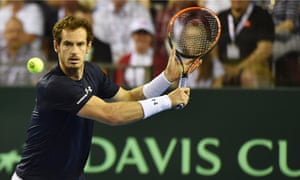
Andy Murray has reached the final of the Davis Cup
He added: "When she comes, it's nice. It's normally at the end of a three or four-week trip. It breaks it up a little bit."
Kim has recently been working on a passion project of her own, after it was revealed she is "helping" her pet dog Maggie to "write" her own book, due for release in June. The book, entitled How to Look After Your Human: A Dog's Guide, explores how pets can bond with their human friends.

Fred Perry’s Davis Cup example can help Andy Murray over ATP finals

Andy Murray attaches huge importance to Great Britain winning a first Davis Cup since 1936.
Andy Murray will agonise for another week before declaring if he will play in the ATP World Tour Finals in London just before the Davis Cup final against Belgium, which it was confirmed on Wednesday will be held on clay in Ghent on 27-29 November.
He said after winning his three matches in the semi-final victory over Australia in Glasgow at the weekend that, because a new back injury has flared, four days would not be enough for him to switch from the hard court of the O2 Arena to clay, but he did not expect the announcement to create such a stir.
The ATP, sponsors and fans who have bought tickets in anticipation of his appearing were taken by surprise and he immediately spoke with his advisers to review his end-of-season schedule. The odds are he will play in London.
Murray’s reluctance to decide quickly reflects the weight of importance he attaches to helping Great Britain win the competition for the first time since 1936, when Fred Perry won the last of four consecutive Davis Cups before turning professional. However, if Murray were looking for inspiration to double up, he might profit from the first of those four cup triumphs in 1933 – which broke a drought of 21 years.
The demands on time were even greater then, given slower modes of travel – although the physicality was a deal less intense. Great Britain won four European Zone ties on clay and grass that summer, against Spain, Finland, Italy and Czechoslovakia, losing only two singles, then beat Australia (conveniently included in the European zone because of their geographical isolation) in the zonal final at Wimbledon.
As Jon Henderson relates in his biography, The Last Champion: The Life of Fred Perry, Great Britain’s esteem in 1933 was wretchedly low the Davis Cup team described by the Daily Express as, “that poor, despised back number of lawn tennis”. They would not remain so for long.
Great Britain beat the Americans and Perry, who still had fitness issues, drew on reserves built up as the most rigorous trainer in the game to drag himself to the line for the title decider against France just four days later. In the second singles he beat Henri Cochet, driving the famed Frenchman into the dirt over five sets, then collapsing in the dressing room.Only a week later, with Perry and Bunny Austin to the fore, they beat the acknowledged masters of the day, the United States, in the semi-final on the clay of Roland Garros. Perry travelled late, after treatment to a shoulder injury, and had his final fitness test by hitting with Dan Maskell 48 hours before the tie.
If the similarities are beginning to sound eerily similar, the story of triumph for Perry and Great Britain on the dreaded foreign clay ought to lift the Scot’s spirits.
The physicality, tempo and attention to detail in the game has changed markedly, perhaps, but the demands of going to Ghent’s Flanders Expo to play on a drop-in clay court in November are not that far removed from those that confronted Perry and his team-mates in 1933. They prevailed – and went on to help Great Britain rule for another four years.

Thứ Bảy, 5 tháng 9, 2015

Milos Raonic waylaid by wonky back, exits U.S. Open

NEW YORK —Milos Raonic fought a noticeable back injury through two rounds of the U.S. Open, but he couldn’t pull off a third escape.
Overcast skies on Friday brought some relief from the blistering heat that contributed to a record number of mid-match retirements through two rounds of the U.S. Open. Two women and 12 men had to stop their matches, the most notable of which was American Jack Sock, who cramped so severely that he held to be carried off the court on Thursday. He was leading two sets to one at the time, but a 32C temperature, coupled with stifling humidity, did him in. The previous record for retirements in a Grand Slam was 10; this tournament easily surpassed that with 10 days of play still remaining.The 24-year-old from Thornhill, Ont., again unable to serve with his usual ridiculous velocity, went down in straight sets to 18th-seeded Feliciano Lopez on Friday in New York. The Spaniard broke the 10th-seeded Canadian three times — and had a whopping 13 break chances, unheard of against Raonic — on the way to a 6-2, 7-6, 6-3 win. Raonic only averaged 190 kilometres per hour on his first serve, about 16 km/h off a typical pace for him, and won 71% of his first-serve points, against a career average about 10 points higher. He said after his second-round win in New York that the back issue, which has bothered him since last month and is unrelated to an earlier foot injury, comes and goes. It was apparent that it was back on Friday, with Raonic labouring and seeking treatment during the match.
Andy Murray, who won a five-set match against France’s Adrian Mannarino in which his opponent noticeably flagged in the heat, said one way to cut down on the number of retirements would be to give first-round money to players who earn their way into the tournament but are not at their best health coming into it.
Al Bello/Getty Images
“I think the player that’s earned the right to be there in the first place, you give them the first-round prize money and you avoid people walking on the court for a few games,” Murray said. “It’s a waste of time for everyone.”
In that scenario, a player with a nagging injury pockets the US$39,500 prize money, but their spot would go to a player who didn’t qualify, who would only make money if they got through to the second round.
But Roger Federer was far less interested in such solutions to the mid-match retirement. His prescription basically amounted to, “Suck it up, muffin.”
“What I don’t understand,” said the five-time champion in New York, “we’ve been here in North America for some time. It’s not like, all of a sudden, hot. I mean, it was more on the warmer side, but it’s not like impossible, to be quite honest.”
“I think everybody should be well-prepared,” Federer said. And: “I think other players should be so fit that heat shouldn’t really matter at that point.”
DON EMMERT/AFP/Getty Images
And here I thought the Swiss were supposed to be diplomatic.
***
Italy’s Sara Errani offered another possible explanation for why some players are not feeling their best: air conditioning.
“In Europe, there’s not this much air conditioning,” Errani said after her Thursday match, as reported by The Associated Press. “Too much back and forth with the temperature,” she said. “You go outside, it’s hot. You come inside, it’s cold. Every time.” A USTA spokesman told the AP that there had been some complaints about the locker rooms and interview rooms being too cold, but that both were kept around 21C.
Al Bello/Getty Images
***
One of the small joys of a major tennis event are the utterly random questions that pop up in post-match press conferences. Because access to players, for most of the 1,000 or so journalists in Flushing Meadows, is limited to these sessions, and many of them are already working on a certain angle to a story, they have to ask their out-of-nowhere question when they get the chance. So, when Andy Murray just finished a five-set triumph on Thursday, a match in which he dropped the first two sets before roaring back, here was the first question posed to him: “Why are you wearing adidas shoes?”
(The short answer: the shoes made by his sponsor, Under Armour, were fine for grass courts but not yet ready for hard courts.)
Later, after Federer complete a straight-sets win, the first question was, suitably, about how he is playing this year relatively to past years. The second question: “Would you vote for Marcelo Rios if you were a voter for the Hall of Fame?”
After saying that he really didn’t know what the criteria was, Federer said Rios, the 39-year-old Chilean who was briefly the top-ranked player in the world, “was one of my favourite players to watch, so I would vote yes.”

Andy Murray looks to vitamin C not tea and sympathy against Thomaz Bellucci

Andy Murray expects to have to deal with his head cold at least until the fourth round of the US Open – if he gets past the 30th seed, Thomaz Bellucci, on Saturday – and he is not looking for sympathy.
“The only thing I’ve taken is vitamin C,” he said after spluttering through five tough sets against Adrian Mannarino on Thursday night and wary of any banned substances lurking in other medications.
“The doctors that are here and part of the Tour can prescribe you stuff that’s fine but there’s no real cure. Hopefully it takes three or four days before it’s out of the system. That’s one of the things about being an athlete. It’s survival of the fittest. There’s not much you can take.”
He can take heart from another courageous fightback, the eighth time in his career he has won after losing the first two sets. Critics who say he played poorly in the first hour and a half are being a bit harsh – although he did make an unholy mess of surrendering the second set – because Mannarino hit a level suited to the occasion.
When lower-ranked players are thrown into big matches they invariably have the talent but not always the self-belief to express it for more than a few points here and there or the extra fitness or sheer determination, sometimes, to survive a serious examination of their tennis, especially over five sets. It is why they never make the breakthrough their early promise holds out for them.
It is why Richard Gasquet, rated as promising as Rafael Nadal when they were teenagers, probably will never win a major. It is why Murray and Novak Djokovic, contemporaries of both of those players, have done.
On Saturday, Murray faces another talented player in Bellucci, who began the year ranked 64 in the world, dipped as low as 87 in March and comes to New York on a steady rise to 30, only nine places adrift of his career best. So he represents danger, as James Ward discovered in the first round.
Murray has been around long enough to dismiss thoughts of an easy win, especially as he is struggling to shake off the cold virus that has hit the locker room. Plus, the conditions here are brutal.
When Jack Sock staggered to a halt with cramp while trying to serve at the start of the fourth set against the Belgian Ruben Bemelmans, then collapsed semi-conscious in front of shocked fans on Thursday afternoon, the physical demands of modern tennis were laid bare for all to see. He was the 13th player to quit the tournament through illness or injury, in only four days.
Sock, a strong young player ranked 28 in the world – who recovered fully after treatment – is as fit as most players on the Tour. Few are fitter than Murray – which is why he is confident of getting through his illness and past Bellucci.
“I didn’t drop that much weight in the match [against Mannarino],” he said. “Over the last few years I’ve got much better at knowing how much I need to drink in certain heat and conditions. I weigh myself before and after every single match. I didn’t drop loads of weight, which is a good thing.”
As for Bellucci, another left-hander, Murray said: “I played Bellucci once, in Madrid. We were at altitude there. He plays well on the clay but I think he plays even better at altitude. I don’t know if he grew up at altitude but he likes it when the conditions are pretty lively, like they are here. He’s obviously playing well.”
What impressed about Murray after surviving such a match that came close to pitching him out of the tournament was his upbeat, almost lighthearted, mood afterwards. Long gone are the post-match blues that dragged his spirit down to dangerously low levels; marriage and impending fatherhood have obviously brought him inner calm.
He was not even particularly riled when Mannarino slammed a full-force volley into his back. “When I got hit with the ball, I wasn’t angry,” he said. “That’s a legitimate play and it happens. I almost deserve that for the bad volley that gave him the chance to do that. When he hit the ball and it was pretty close to my head after the point had finished, I didn’t like that so much.”
Murray, who took unnecessary abuse for his support of Scottish independence earlier this year, has found a new cause, the World Wildlife Fund, and wears their badge on his shirt.
“It’s quite a nice thing to do, helping a charity. I love animals. I’ve spoken with Matt [Gentry, his business adviser] about doing stuff for charities. I care as much about animals as I do about human beings. Some people find that funny, I don’t find it funny. I just think that we’re all on this planet together and it’s horrible when you see what happens to some animals that are almost extinct. There was that story about Cecil the lion a few weeks ago. It’s horrible. Anything you can do to help. They don’t have a voice, human beings do. It’s nice to try to help with that.
“The thing with animals is you have to kind of accept things. I love my dogs. You can teach them to behave. But if they decide by themselves that they’re going to be naughty, you just have to accept that, whereas with people, it’s a lot easier to discipline them and tell them the difference between right and wrong.”
Warming to the subject – when most other players might have rushed for the late-night courtesy car back to a hotel – Murray shared a childhood episode that, well, read it for yourself …
“I grew up with animals. My family always had dogs. I had a couple of hamsters when I was a kid. The first one that I had was called Whisky. I lost him down the back of a sink. You know how in a house you would have just a sink in a bedroom? I wrapped a duvet round the back of the sink to stop the hamster from getting in there. I don’t know how it managed to get under the duvet.
“I used to just let it out and run around. It got behind the sink and went under the floorboards. I left a mousetrap, not one that would kill but one that would catch it if it came out of the floorboards. I woke up the next morning, the bit of cheese was gone, the mousetrap hadn’t worked. It had obviously got up there and got the food – and that was that.”