Nhãn

Hiển thị các bài đăng có nhãn Roger Federer. Hiển thị tất cả bài đăng

Thứ Tư, 9 tháng 11, 2016

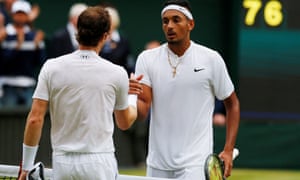
Nick Kyrgios and Andy Murray: the bromance capable of saving a career

Andy Murray and Nick Kyrgios

The Australian looks up to the new world No1 more than anyone and could not hope to have a better role model as he looks to get his tennis career back on track

It was a three-word tweet which spoke volumes. No sooner had Andy Murray completed his remarkable ascension to the top of men’s tennis, Nick Kyrgios paid homage on social media. “U the man” wrote the Australian before posting a picture of him rubbing Murray’s head. A heartwarming tennis “bromance” for the ages.
Though as the 21-year-old licks his wounds following a meltdown in Shanghai last month which earned severe ATP sanctions and sessions with a sports psychologist, watching his buddy reach for the stars can only have a positive effect. There is, after all, much of Murray in Kyrgios. Both are hot-headed, emotional, complex characters. Their respective countries have endured a relative dearth of success which brings its own pressures.
The best sportsmen are often enigmas, curious puzzles which are fiendishly difficult to solve. Both fall into that category, yet are also rampaging talents on the tennis court. And, that’s why Murray, a world-class superstar with no airs or graces, has constantly been available to help the young Australian deal with the troubles which pollute his undoubted brilliance with racquet in hand.
“Dealing with criticism is hard to take, but Andy has been there and been brilliant with Nick in helping him understand the process,” a source close to Kyrgios told the Guardian. “There’s no manual on how to deal with being famous. He tells him not to get carried away when everything is going to plan and tells him straight when it starts to get ugly. Nick looks up to him more than anyone. There is no one he respects more, and seeing what Andy has achieved is all he needs to take his career forward.”
The Scot is always available – text, WhatsApp, call, or email. Novak Djokovic has also opened the airwaves, something for which he has been appreciative, yet Murray is Kyrgios’s go-to man. The pair are planning a training block together in the coming months. Murray, a relentless athlete in the gym, wouldn’t invite just anyone into the sweatbox of his inner sanctum. He recognises that Kyrgios works hard off the court, even if his demeanour invites large swathes of criticism from those who are unable to see the whole picture.
Certainly among his peers, the Australian isn’t shunned in the locker room or given the cold shoulder. Of course, he’s not everyone’s cup of tea. His relationship with Stan Wawrinka suffered following their unseemly bust-up last August but has now healed. Yet his tennis talents help him earn respect with others.
On tour, a senior group including Murray, Jo Wilfried Tsonga, Gael Monfils, and John Isner will hang out with him in foreign climes. In hotel rooms, gaming-console duels on Fifa are keenly fought. Undoubtedly, the battles in Kyrgios’ mind are harder to combat.
Yet, Murray knows the pitfalls in which younger players can find themselves. The 29-year-old has been there. Hitting the ball over the net is the straightforward part. Dealing with strains and stresses of sporting stardom, however, is a harder nut to crack and one with which Kyrgios has struggled.
The meltdown in Asia was symptomatic of his inability to cope. With Tokyo tournament sponsor Yonex earmarking one of their clients, Kyrgios, as a marquee player, everyone wanted a piece. The off-court demands were incessant, yet there we no complaints. It’s all part of the game.
A superb week, one of the best in his career, which resulted in a winner’s trophy, soon followed but within 48 hours, he was in Shanghai, starting all over again. No gap, no time for breathing space. The denouement was brutal and the repercussions seismic. Something had to give, and even though Sam Querrey was dispatched in straight sets, against Germany’s Mischa Zverez, he cracked. Serving underarm and arguing with fans is never a good idea.
It looked awful. The critics once again had bucketloads of ammunition to unload. The firestorm blazed. How could it not? “It was terrible and Nick knows he has to do better than that,” the source said. “It was constant between Tokyo and Shanghai. Playing and doing everything else has taken its toll.
“But dealing with everything that comes with being one of the best players in the world is a learning process, and that’s where someone like Andy can come in and help. Nick loves him.”
Now is the time for this supremely talented student to follow his world-dominating teacher’s lead. There is no better role model.

More games: friv

Thứ Năm, 7 tháng 4, 2016

Nick Kyrgios won’t chase rankings points as he strives for success at major tournaments

NICK Kyrgios will ignore the temptation of blindly chasing rankings points and instead embrace a “quality over quantity” approach ahead of the French Open and Wimbledon.
Increasingly viewed as the player most likely to threaten the dominance of Novak Djokovic, Roger Federer, Andy Murray, Rafael Nadal and Stan Wawrinka, Kyrgios will take the next three weeks off to build on a strong start to the season.
A semi-finalist at the rich Miami Open last week after victory in Marseilles in February, world No.20 Kyrgios will use the three-week block to prepare for next month’s French Open.
The youngest man inside the top 20, Kyrgios won’t play another tournament until Estoril from April 25.
After returning to the scene of what he regards as his greatest victory — success over 17-time major winner Federer — Kyrgios will then contest the Madrid and Rome Masters 1000 tournaments before taking another week off.
He will then tackle Roland Garros before shifting focus to his primary goal — the English grass court season, where he is already a feared commodity.
The 20-year-old has been added to a classy Queen’s Club field, where he shares to billing with world No.2 Murray, Nadal, Wawrinka and Canadian Milos Raonic.
After Queen’s, Kyrgios will take another week off to make final preparations for Wimbledon, where he announced himself to the world in spectacular fashion two years ago with a centre court demolition of then world No.1 Nadal.
Nick Kyrgios is seen as a big threat to the stars of the men’s game. Picture: Matthew Stockman/Getty Images
Reinstated as Australian No.1 after overtaking Bernard Tomic with his deep Miami run, Kyrgios is widely regarded as a serious danger at Wimbledon because of his massive serve and vastly improved returning and mobility.
The Canberran proved in Miami that he is far from a one-trick serving pony, compensating for unusual inconsistency on his biggest weapon with classy returning.
Still without a permanent coach, Kyrgios is again likely to tap into Davis Cup captain Lleyton Hewitt’s grass court expertise.
Hewitt won four Queen’s Club titles as well as the 2002 Wimbledon crown.
Kyrgios, world No.21 Tomic and world No.26 Sam Stosur are all likely to be seeded at the next two majors.
Daria Gavrilova, ranked 37th, is also in the mix.

Thứ Sáu, 4 tháng 12, 2015

True or false: Early 2016 tennis predictions

After a thrilling 2015 tennis season on both the men's and women's tours, we have a moment to catch our breath and look into the future. Will Serena maintain her WTA dominance? And will Andy Murray's momentum continue into the 2016 Slam season? Our experts weigh in on these issues and more.

Andy Murray will parlay his Davis Cup championship into at least one Grand Slam title in 2016.


Bodo: False. Winning the Davis Cup in 2010 was clearly a springboard for Novak Djokovic's three-Slam performance in 2011. The thing is, Andy Murray is not Djokovic, and he's not at a comparable stage of his career. The problem for Murray is he isn't the superior player at any of the majors, partly because he's a better three-set than five-set performer. Barring a major, unexpected upset or two at a Grand Slam event, Murray simply isn't consistently good enough to hammer his way through to the championship.
Garber: True. It's been a while since he won his two previous majors -- the 2012 US Open and 2013 Wimbledon -- but as his Davis Cup triumphs prove, he can still find the fire. Next year, he'll put a lot less energy into Davis Cup and more into the Grand Slams. I don't think it's a stretch to see him winning either Wimbledon or the US Open again.
Isaacson: True. It's as good a time as any, since Murray is physically fit, had as consistent a 2015 season as he ever has, and is riding some pretty decent momentum. He said he's gunning for the two Slam titles he hasn't yet won -- the Australian and French Opens -- and he was close in both in 2015, losing to Novak Djokovic twice (in the finals in Melbourne and semis in Paris). Fatherhood (in February) could inspire him. If he doesn't win one in 2016, it will be a disappointment for the world No. 2.

Novak Djokovic will win at least three of the big five events in 2016 (including the Olympics).

Bodo: True. Now that Djokovic has 10 majors, he'll be super motivated to catch Rafael Nadal's 14 and perhaps even Roger Federer's record 17. Time is on the 28-year-old Djokovic's side. Federer is 34. Nadal struggled through 2015 and didn't even make a major semifinal. Djokovic is 21-9 against his true generational rival, Murray, having prevailed in nine of their past 10 matches. And Djokovic is an overpowering 19-4 against two-time Slam winner Stan Wawrinka. Three of the big five events of 2016 will be on hard courts, including the Rio Olympics. Djokovic could win them all -- and more.
Garber: False. The past three times a man has won three of the four majors (Roger Federer in 2007, Rafael Nadal in 2010 and Djokovic in 2011), he followed that up by reaching three Grand Slam singles finals the following year -- and winning only one. The triple-Slam effort simply takes too much out of the body and mind. The Olympics make this one interesting; I can see a scenario in which Murray, Nadal and a surprise mystery guest (Milos Raonic, Kei Nishikori, Grigor Dimitrov?) win three of the five big titles.
Isaacson: False. I want to say true, merely because of how much he looked to want payback after reluctantly playing the evil role to Fed's good in September's US Open final. I also want to say yes because he was so dominant in 2015. But if the Open showed us anything, it's that even Djokovic can be vulnerable at times, and with the Olympics thrown in, it's tough to imagine he will have the mental and physical stamina to pull off three of the big five.

Rafael Nadal is more likely than Roger Federer to win a Grand Slam in 2016.

Bodo: False. No disrespect to Nadal who's been down on his luck, but in 2015, he left Federer all alone on the "Stop Djokovic" bandwagon. Throw in Nadal's nagging health issues, ranging over time from bad knees to a sore back to a bad elbow to a bad wrist, and it's obvious his two priorities for the new year will be finding -- and maintaining -- his vanished consistency and remaining healthy. Sure, he could win the French Open for a 10th time, but based on what we saw in 2015, he will have enough trouble doing that -- never mind any of the other majors.
Garber: True. It was terrific to see Federer get the finals at Wimbledon, the US Open and the Barclays in London. But at age 34, he just doesn't have the stuff to take down an in-form Djokovic. Rafa had some pep in his step in London, and even though he failed to win a major for the first time in 11 years, he will rebound with his 10th French Open title next spring.
Isaacson: True. This is not to say that either Rafa or Fed will win a Slam in 2016; I don't think they will. But Nadal may be slightly more likely, if only because as much as 2015 seemed to signal the beginning of the end, he is not looking presently like a man who wants to retire very soon. He reached the finals in Beijing and Basel, beat Wawrinka and Murray in the ATP Finals round-robin, and is much healthier than he has been recently. A Slam in '16 is not inconceivable.

Serena Williams will end 2016 as the world No. 1.

Bodo: True. Serena Williams is due for a big letdown after her spectacular 2015. So what? The rest of her WTA peers amply demonstrated that none of them has the chops, or the game, to step in and dominate. That means Serena could have an off year and still end up No. 1. Her most dangerous challenger at the moment appears to be No. 3 Garbine Muguruza. But it's not at all certain that the 22-year-old has the consistency to play at an elite level week in, week out.
Garber: True. At the moment, Serena is nearly 3,900 points ahead of the No. 2-ranked Simona Halep. Even if she takes a predictable step backward from her wondrous 2015 season, Serena has enough of a cushion to stay at No. 1.
Isaacson: True. Virtually every time we count her out, she surprises us, and as far away from tennis as she seems to be right now, Serena still has the capability to hold onto that ranking, if nothing else. She has plenty of points to defend next year, but she also has a huge head start on the rest of the pack.

Venus Williams will finish 2016 in the top 10.

Bodo: True. Venus Williams had a great 2015, finishing No. 7. Expect more of the same in 2016. She's 35, but that's not an overwhelming handicap in today's game. The grind is easier for her to bear as long as her sister Serena is around. The two love playing doubles together. And the Olympics mean a lot to both Williams sisters. That will motivate Venus in the early part of 2016 because staying in the top eight will guarantee her critical seeding advantages. Her health could be the determining factor in her status.
Garber: False. While it was great to see Venus go 41-13 this year, win three titles and $2.4 million, and finish at No. 7, there are a handful of far younger players lurking just behind her. Karolina Pliskova, Timea Bacsinszky, Carla Suarez Navarro, Belinda Bencic and Madison Keys would love to vault over Venus. Plus, Caroline Wozniacki -- outside the top 15 for the first time in eight years -- is due for a better season.
Isaacson: True. This is a tough one because Venus popped back into the top 10 in 2015 for the first time in four years. It was no fluke in a year made up mostly of bad draws -- she was in Serena's half in every major -- and Venus finished the year with two titles in the China swing, and her best overall season since 2007. Even with the Karolina Pliskovas and Timea Bacsinszkys of women's tennis bearing down on the top 10, there is room for a motivated Venus to hang in.

Thứ Bảy, 5 tháng 9, 2015

Milos Raonic waylaid by wonky back, exits U.S. Open

NEW YORK —Milos Raonic fought a noticeable back injury through two rounds of the U.S. Open, but he couldn’t pull off a third escape.
Overcast skies on Friday brought some relief from the blistering heat that contributed to a record number of mid-match retirements through two rounds of the U.S. Open. Two women and 12 men had to stop their matches, the most notable of which was American Jack Sock, who cramped so severely that he held to be carried off the court on Thursday. He was leading two sets to one at the time, but a 32C temperature, coupled with stifling humidity, did him in. The previous record for retirements in a Grand Slam was 10; this tournament easily surpassed that with 10 days of play still remaining.The 24-year-old from Thornhill, Ont., again unable to serve with his usual ridiculous velocity, went down in straight sets to 18th-seeded Feliciano Lopez on Friday in New York. The Spaniard broke the 10th-seeded Canadian three times — and had a whopping 13 break chances, unheard of against Raonic — on the way to a 6-2, 7-6, 6-3 win. Raonic only averaged 190 kilometres per hour on his first serve, about 16 km/h off a typical pace for him, and won 71% of his first-serve points, against a career average about 10 points higher. He said after his second-round win in New York that the back issue, which has bothered him since last month and is unrelated to an earlier foot injury, comes and goes. It was apparent that it was back on Friday, with Raonic labouring and seeking treatment during the match.
Andy Murray, who won a five-set match against France’s Adrian Mannarino in which his opponent noticeably flagged in the heat, said one way to cut down on the number of retirements would be to give first-round money to players who earn their way into the tournament but are not at their best health coming into it.
Al Bello/Getty Images
“I think the player that’s earned the right to be there in the first place, you give them the first-round prize money and you avoid people walking on the court for a few games,” Murray said. “It’s a waste of time for everyone.”
In that scenario, a player with a nagging injury pockets the US$39,500 prize money, but their spot would go to a player who didn’t qualify, who would only make money if they got through to the second round.
But Roger Federer was far less interested in such solutions to the mid-match retirement. His prescription basically amounted to, “Suck it up, muffin.”
“What I don’t understand,” said the five-time champion in New York, “we’ve been here in North America for some time. It’s not like, all of a sudden, hot. I mean, it was more on the warmer side, but it’s not like impossible, to be quite honest.”
“I think everybody should be well-prepared,” Federer said. And: “I think other players should be so fit that heat shouldn’t really matter at that point.”
DON EMMERT/AFP/Getty Images
And here I thought the Swiss were supposed to be diplomatic.
***
Italy’s Sara Errani offered another possible explanation for why some players are not feeling their best: air conditioning.
“In Europe, there’s not this much air conditioning,” Errani said after her Thursday match, as reported by The Associated Press. “Too much back and forth with the temperature,” she said. “You go outside, it’s hot. You come inside, it’s cold. Every time.” A USTA spokesman told the AP that there had been some complaints about the locker rooms and interview rooms being too cold, but that both were kept around 21C.
Al Bello/Getty Images
***
One of the small joys of a major tennis event are the utterly random questions that pop up in post-match press conferences. Because access to players, for most of the 1,000 or so journalists in Flushing Meadows, is limited to these sessions, and many of them are already working on a certain angle to a story, they have to ask their out-of-nowhere question when they get the chance. So, when Andy Murray just finished a five-set triumph on Thursday, a match in which he dropped the first two sets before roaring back, here was the first question posed to him: “Why are you wearing adidas shoes?”
(The short answer: the shoes made by his sponsor, Under Armour, were fine for grass courts but not yet ready for hard courts.)
Later, after Federer complete a straight-sets win, the first question was, suitably, about how he is playing this year relatively to past years. The second question: “Would you vote for Marcelo Rios if you were a voter for the Hall of Fame?”
After saying that he really didn’t know what the criteria was, Federer said Rios, the 39-year-old Chilean who was briefly the top-ranked player in the world, “was one of my favourite players to watch, so I would vote yes.”

Thứ Hai, 10 tháng 8, 2015

Andy Murray’s impressive form not fuelled by off-court happiness

It is too easy to say the Scot’s success is due to impending parenthood and his settled life with Kim Sears – elite athletes have the ability to separate work from their personal lives

Andy Murray


Andy Murray is going to be a father in February according to best estimates – which might inconvenience his participation in the Australian Open in January – and everybody is happy for Britain’s best player and his wife, Kim.
However, the rush this week to celebrate their impending parenthood by linking it unequivocally to Murray’s excellent form (since they married in April, he is 27-4, including a strategic walkover in Rome and a blip loss in Washington this week) is fuelled as much by sentiment as science.
It is an understandable urge. Everyone wants to see Mr Grumpy smiling and winning, but Mr Grumpy has shown us down the years he is capable of winning or losing whether he is grinning idiotically or swearing his head off.
This is a conundrum Murray has wrestled with for a long time and his revelation recently that he has been talking to a psychiatrist to better understand the workings of not just his own mind shows his concern.
There is no sensible reason to assume Murray is more or less likely to win a third grand slam title at the US Open next month because he is contemplating the joy of sleepless nights than there is to say that Roger Federer, proud father of two sets of twins, will continue to be the game’s éminence grise until his right arm drops off or he collapses in a 34-year-old heap at Flushing Meadows.
After all, the daddy of all tennis daddies has won four of his 17 majors since he married Mirka Vavrinec in April 2009, followed quickly by the arrival of their first twins: the Rafael Nadal-free French Open and Wimbledon that year, the Australian Open final in 2010 against Murray and the 2012 Wimbledon final, also against Murray.
Those are numbers that hardly diminish Federer’s achievements, but they lend them perspective. Was Federer a better player before he became a father? Perhaps, although it is difficult to say – but certainly he was younger.
What of the seemingly eternal Spanish bachelor Nadal? Will he or won’t he, at 29, add to his 14 slam titles if there is any substance to the rumour that he has finally asked Xisca Perello to marry him?
Tomas Berdych announced his engagement to Ester Satorova at the Australian Open this year (didn’t loyalKim give him her tuppence worth during Andy’s win over the Czech in the semi-finals?) and they married last month. It will be interesting to see how he finishes the season.
While it is clear Murray at 28 is playing with a smile on his face and has rediscovered the freedom of his youth, there is a better case to be made that this stems from a hard-headed decision to fine-tune his tennis, a strategic shift encouraged, as it happens, by Amélie Mauresmo, who is due to give birth any day.
If anything, Murray is a more aggressive ball-striker since Mauresmo’s arrival in his life in 2014 than he was in the two years he played under the guidance of the stridently macho Ivan Lendl. So there, at least, is some evidence that he responds as much to understated encouragement as he does to loud, male hailing.
The view that the only happy athlete is a married athlete is a societal judgment, not unlike the one this government would like to impose on unmarried parents or partners of inconvenient gender. As Murray said after losing to Djokovic in the Australian Open final this year, success is being happy. What he did not say is that happiness is being successful.
Take, for instance, Stan Wawrinka, who won his second major by winning the French Open this summer despite the weight of a publicly crumbling relationship with his wife and the apparent marital serenity of the man he beat, the ever-smiling Djokovic. He rose above his circumstances because, correctly or not, tennis defines him.
What is apparent from sporting history is special athletes are capable of compartmentalising their lives. They have the selfish gene, the one that blocks out all others. Muhammad Ali had some of his greatest wins while his personal life was in turmoil, as did Mike Tyson for a long time.
Still, it is stating the obvious to point out we are all different, even champions. Caroline Wozniacki said a couple of months ago of her split with Murray’s close golfing friend, Rory McIlroy, at the start of 2014, “I didn’t know how strong I was until that happened.”
Wozniacki struggled for more than a year then prospered again, pretty much to the limit of her abilities. McIlroy, meanwhile, established himself as the best in the world, Jordan Speith notwithstanding.
In sport, myth too often conquers fact, or at least wrestles with it. Don’t believe what you feel; believe what you see. And, even then, have another look. Otherwise the bookies will take you to the cleaners.