Thứ Tư, 22 tháng 6, 2016

Andy Murray seeded second and Johanna Konta No17 at Wimbledon

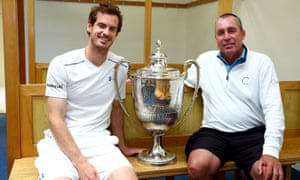
Andy Murray has reunited with his former coach Ivan Lendl which paid immediate dividends when he won Queen’s.
Andy Murray will be seeded second at Wimbledon as the British No1 targets his third grand slam title.
Murray, who ended Britain’s 77-year wait for a men’s champion at the All England Club in 2013, will be in a separate half to the top seed Novak Djokovic when the draw is made on Friday.
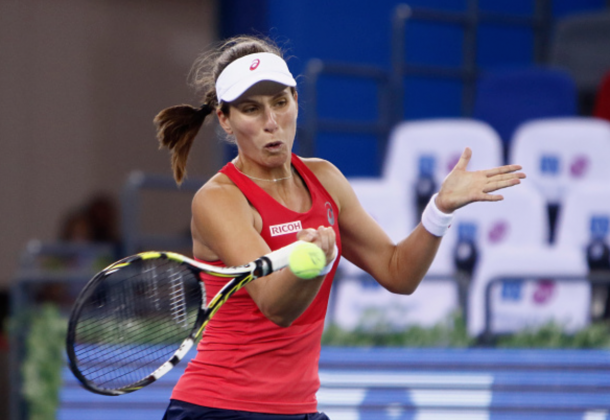
In the women’s tournament, Johanna Konta is the first British female to be seeded at Wimbledon since Jo Durie in 1984. Konta is seeded 17th.
Her placing is a reward for a remarkable 12 months, in which she has reached the last 16 at the US Open and the semi-finals at the Australian Open. The 25-year-old’s world ranking has shot up from 146th to 18th.
Murray’s seeding means he cannot face the world No1 Djokovic, who currently holds all four grand slam titles, until the final. Murray has lost 13 of his last 15 matches against the Serb, including the Australian and French Open finals this year, but he has won their last two meetings on grass.
The 17-times major champion Roger Federer is seeded third and his Swiss compatriot Stan Wawrinka four. Canada’s Milos Raonic, who has hired John McEnroe as coach, is sixth.
Serena Williams will be top seed in the women’s draw as the American looks to equal Steffi Graf’s open-era record by sealing a 22nd grand slam triumph.
Williams has failed at the last hurdle in her last two major tournaments, enduring surprise defeats at the Australian and French Open finals this year.
Her conqueror at Roland Garros, Garbiñe Muguruza of Spain, is seeded second with Poland’s Agnieszka Radwanska, the 2012 finalist, third.
Seedings at Wimbledon are determined using a combination of a player’s ranking points and their results in grass-court matches. Play at the third grand slam tournament of the year starts on Monday.

List of seeds

MEN
1 Novak Djokovic (Serbia)
2 Andy Murray (Britain)
3 Roger Federer (Switzerland)
4 Stan Wawrinka (Switzerland)
5 Kei Nishikori (Japan)
6 Milos Raonic (Canada)
7 Richard Gasquet (France)
8 Dominic Thiem (Austria)
9 Marin Cilic (Croatia)
10 Tomas Berdych (Czech Republic)
11 David Goffin (Belgium)
12 Jo-Wilfried Tsonga (France)
13 David Ferrer (Spain)
14 Roberto Bautista Agut (Spain)
15 Nick Kyrgios (Australia)
16 Gilles Simon (France)
17 Gaël Monfils (France)
18 John Isner (US)
19 Bernard Tomic (Australia)
20 Kevin Anderson (South Africa)
21 Philipp Kohlschreiber (Germany)
22 Feliciano López (Spain)
23 Ivo Karlovic (Croatia)
24 Alexander Zverev (Germany)
25 Viktor Troicki (Serbia)
26 Benoît Paire (France)
27 Jack Sock (US)
28 Sam Querrey (US)
29 Pablo Cuevas (Uruguay)
30 Alexandr Dolgopolov (Ukraine)
31 João Sousa (Portugal)
32 Lucas Pouille (France)
WOMEN
1 Serena Williams (US)
2 Garbiñe Muguruza (Spain)
3 Agnieszka Radwanska (Poland)
4 Angelique Kerber (Germany)
5 Simona Halep (Romania)
6 Victoria Azarenka (Belarus)
7 Roberta Vinci (Italy)
8 Belinda Bencic (Switzerland)
9 Venus Williams (US)
10 Madison Keys (US)
11 Petra Kvitova (Czech Republic)
12 Timea Bacsinszky (Switzerland)
13 Carla Suárez Navarro (Spain)
14 Svetlana Kuznetsova (Russia)
15 Samantha Stosur (Australia)
16 Karolina Pliskova (Czech Republic)
17 Johanna Konta (Britain)
18 Elina Svitolina (Ukraine)
19 Sloane Stephens (US)
20 Dominika Cibulkova (Slovakia)
21 Sara Errani (Italy)
22 Anastasia Pavlyuchenkova (Russia)
23 Jelena Jankovic (Serbia)
24 Ana Ivanovic (Serbia)
25 Barbora Strycova (Czech Republic)
26 Irina-Camelia Begu (Romania)
27 Kiki Bertens (Netherlands)
28 Coco Vandeweghe (US)
29 Lucie Safarova (Czech Republic)
30 Daria Kasatkina (Russia)
31 Caroline Garcia (France)
32 Kristina Mladenovic (France)

Thứ Ba, 17 tháng 5, 2016

Murray hopes to have new coach after French Open, would 'love' Lendl

Andy Murray says he is unlikely to appoint a new coach before the French Open but is willing to move his training base from Miami to accommodate the right candidate, with Ivan Lendl still being strongly linked.
Two weeks have passed since the world No.2 split from Amelie Mauresmo but he is keen to add a new head coach to his team before the start of the grass-court season.
Speculation has centred on Lendl from the outset, with Murray's most successful period -- between 2012 and 2014 when he won the US Open, Wimbledon and an Olympic gold medal -- coming while he was working with the Czech-born American.
The Briton's golden days with Lendl ended because of conflicting time pressures, the coach wanting to focus on setting up a tennis academy in South Carolina, which has since closed.
But Murray has been repeatedly asked whether he would like to get the team back together and both men have hinted they would be pleased to do so.
"I'd love to work with Ivan but the time was the issue," Murray told British newspapers, who secured an impressive victory against Novak Djokovic in last weekend's Italian Open final.
"If it can work then I'd love to do it, but it has to work for both of us. People who have been No.1 in the world know the amount of time it takes to make an impact.
"To be fair to Boris Becker, he is there with Djokovic a lot. He has dedicated a lot of time to it. It's the travel that's normally the issue. I'm willing to make compromises where I train and stuff. It was good in Miami because Ivan's close to there.
"It's unlikely something will happen before the French but the grass is three weeks away so there's time. Maybe I will try to speak to a couple of people next week if the team have some agreement."
Murray's assistant coach, Jamie Delgado will oversee his preparations for the French Open, a role he fulfilled for the Italian Open and Madrid masters after breaking away from Mauresmo.
"We hadn't seen each for a long time and things were working well with Delgado," Murray said, referring to his former French coach. "Although it's unfortunate, it's good that I have a clear head for the next few months.
"Having a bit of clarity and knowing what you are looking at moving forward is important. It can free you up a bit because if you are thinking about something a lot, especially when it comes to someone you are working with in your team that's unhappy or something's not working well. That's when thoughts come on the court and you lose your concentration a bit."

Thứ Năm, 7 tháng 4, 2016

Nick Kyrgios won’t chase rankings points as he strives for success at major tournaments

NICK Kyrgios will ignore the temptation of blindly chasing rankings points and instead embrace a “quality over quantity” approach ahead of the French Open and Wimbledon.
Increasingly viewed as the player most likely to threaten the dominance of Novak Djokovic, Roger Federer, Andy Murray, Rafael Nadal and Stan Wawrinka, Kyrgios will take the next three weeks off to build on a strong start to the season.
A semi-finalist at the rich Miami Open last week after victory in Marseilles in February, world No.20 Kyrgios will use the three-week block to prepare for next month’s French Open.
The youngest man inside the top 20, Kyrgios won’t play another tournament until Estoril from April 25.
After returning to the scene of what he regards as his greatest victory — success over 17-time major winner Federer — Kyrgios will then contest the Madrid and Rome Masters 1000 tournaments before taking another week off.
He will then tackle Roland Garros before shifting focus to his primary goal — the English grass court season, where he is already a feared commodity.
The 20-year-old has been added to a classy Queen’s Club field, where he shares to billing with world No.2 Murray, Nadal, Wawrinka and Canadian Milos Raonic.
After Queen’s, Kyrgios will take another week off to make final preparations for Wimbledon, where he announced himself to the world in spectacular fashion two years ago with a centre court demolition of then world No.1 Nadal.
Nick Kyrgios is seen as a big threat to the stars of the men’s game. Picture: Matthew Stockman/Getty Images
Reinstated as Australian No.1 after overtaking Bernard Tomic with his deep Miami run, Kyrgios is widely regarded as a serious danger at Wimbledon because of his massive serve and vastly improved returning and mobility.
The Canberran proved in Miami that he is far from a one-trick serving pony, compensating for unusual inconsistency on his biggest weapon with classy returning.
Still without a permanent coach, Kyrgios is again likely to tap into Davis Cup captain Lleyton Hewitt’s grass court expertise.
Hewitt won four Queen’s Club titles as well as the 2002 Wimbledon crown.
Kyrgios, world No.21 Tomic and world No.26 Sam Stosur are all likely to be seeded at the next two majors.
Daria Gavrilova, ranked 37th, is also in the mix.

Thứ Bảy, 30 tháng 1, 2016

Australian Open Finals: Here's Why Andy Murray Will Beat Novak Djokovic

Andy Murray will surely beat Novak Djokovic when the two meet Sunday in the Australian Open finals. Of that, I can be sure — unless, of course, you read something that says the exact opposite.
Murray’s run in this tournament hasn’t been exquisitely smooth. He only lost a combined 11 games in his first two matches, but 32nd-ranked Joao Sousa took a set off him in the third round and he later had a tight three-set win vs. Bernard Tomic. Then, in the semifinals, Milos Raonic won two of the first three sets vs. Murray, meaning Murray had to battle back for the 4-6, 7-5, 6-7 (4-7), 6-4, 6-2 victory to advance to the finals for the third time in four years.
But the five-setter shouldn’t affect Murray’s chance vs. Djokovic. As former Wimbledon champion Pat Cash said, via the BBC: “This match won’t have taken an awful lot out of Murray — the rallies weren’t that long. He was moving very well at the end and was playing confidently. He knows where he failed in last year’s final against Djokovic. He knows he must keep the pressure up and can’t afford any lapses. Last year he was at himself the whole time. He shouldn’t have been but he couldn’t stop himself and for his sake I’m hoping he has learnt the lessons from that and can control his emotions.”
Andy Murray is playing in his third Australian Open finals in the past four years. (Photo by Scott Barbour/Getty Images)
Thus, one should make no mistake. Murray will beat Djokovic in a rematch from the 2015 Australian Open finals. Here are three reasons why.
1) Murray has successfully battled through his off-court distractions:Coming into the tournament, Murray had plenty of thoughts on his mind. Murray’s pregnant wife, Kim Sears, is due to give birth to their first child soon, and earlier in the tournament, his father-in-law, Nigel Sears, collapsed in the stands and had to be rushed to the hospital. Murray has had some emotional moments on the court during the tournament and he even considered withdrawing altogether, but he’s fought through those moments effectively. “Things have obviously happened with family at other stages, but not in the middle of a Grand Slam and with Kim obviously heavily pregnant, as well,” Murray said, via the Mirror.
“One thing I’ve done very well is fight for every single point and not given away games. Even when I’ve been broken, I’ve fought hard in the next game and made it very difficult for my opponents. Although I’m not exactly being very positive with myself, I’m still very difficult for my opponents and fighting hard for every point. I’m more proud of how I’ve handled myself away from the court. I think I’ve dealt with everything away from the court better than I have on it probably.”

2) Although Murray has been dominated by Djokovic lately, he still has confidence: Since the beginning of 2014, Djokovic has beaten Murray in 10 of the 11 matches they’ve played, calling to mind the dominance of Serena Williams and her 18-straight victories vs. Maria Sharapova. But Murray, who has a 9-21 lifetime record vs. Djokovic, has beaten him in big arenas — triumphing in the 2013 Wimbledon and 2012 U.S. Open finals — and he seemingly is still confident in himself. “I have a very good shot on Sunday if I play my best tennis,” Murray said, via the Guardian. “… I don’t think many people are expecting me to win. I just have to believe in myself, have a solid game plan, and hopefully execute it. It doesn’t matter what’s happened in the past. People like to read into what’s happened, but Stan [Wawrinka] beat Rafa [Nadal] in the final here [in 2014]. He’d never won against him in [12] attempts. There’s no reason it’s not possible for me to win.”

Australian Open 2016 men's final: Can Andy Murray 'Ashe' Novak Djokovic?

It's hard to recall a men's grand slam final between the world Nos. 1 and 2 in which the latter is given so little chance of winning.
In 1996, No. 1 Pete Sampras played No. 2 Michael Chang in the final of the US Open - and swotted little Mike like a blowfly. But Chang's ranking flattered his true capabilities in that period.
Andy Murray is a legit No. 2, narrowly ahead of Roger Federer. He's lost four finals here, Novak Djokovic has won five. The personal scorecard is 3-0 in the Melbourne Park final and, based on results in 2015, the distance between Novak and Andy (between Novak and everyone) has widened further.

Murray celebrates his victory over Milos Raonic.
Murray celebrates his victory over Milos Raonic. Photo: Alex Ellinghausen
If Murray was fortunate to survive Milos Raonic's thunderbolts, he can't be said to have enjoyed an easy or uneventful tournament: His father-in-law collapsed in the stands, he had to endure the Bernie Tomic show then David Ferrer and has just escaped a nasty five-setter against Raonic.

Meanwhile, his wife Kim is eight-and-a-half months pregnant. Murray has said if she's suddenly in labour, he'd pull the pin on whatever match is next, though we assume Kim won't call with contractions if he's serving at 6-5 in a tiebreaker.
So Murray has plenty on his mind. He will need to exercise it for this final and, in Amelie Mauresmo, he might have the right Gallic cornerwoman to help devise a Djoker-slaying plan.
It will not have been lost on Mauresmo that her countryman Gilles Simon unexpectedly gave Djokovic a serious five-set fright. The most notable number from that game was this stunner: Novak made 100 unforced errors.
How did this happen? We cannot discount that Djokovic simply had a downer. Unfortunately for Murray, that's hardly the basis for a successful game plan.
But Simon, who's ranked No. 15, did bring something quite different to the round-of-16 match, compared with nearly every other Djoker victim.
"I know exactly what I was doing, but I won't say it," Simon said after pushing Djokovic to five sets. "I had a plan. I mean, I know him well. We all know which player he is and how hard it is to find any solution against him, to somehow stop the fight and feel better on the court."
What Simon did to Djokovic was to regularly slow down the pace from the backcourt, often hitting to a central position (in width, not depth), rather than the lines. But having taken pace off for some shots, he would abruptly unload a powerful, fast shot.
It's called mixing it up. Bowlers try this on batsman they can't get out.
Djokovic is comfortable with pace on the ball and is nonpareil in covering angled shots. Simon gave him neither. Djokovic, for once in a while, didn't know was coming.
Older tennis people with a remembrance of finals past would know that Simon's - ultimately unsuccessful - attempt to slay this serial winner had a famous historical parallel, just over 30 years ago.
In 1975, Jimmy Connors was the game's El Supremo - he's gone 99-4 the previous year. Jimmy hit the ball hard, fast and flat. If you belted it at him, he'd send it back with compound interest.
The late and great Arthur Ashe, then 32, devised a plan for that final: hit the ball softly, slice it, keep it low; don't give Connors anything to whack back.
Ashe won in four sets, in what was a popular upset - the considered Ashe was a champion of his fellow players' rights, Connors a pugnacious, solitary figure who had boycotted the USA Davis Cup team
Djokovic is no less affable than Murray, and Ashe moved Connors around more, so the comparison has some wrinkles. But the overriding point is this: Simon slowed the tempo against a counter-puncher and removed Djoker from his comfort zone, seemingly irritating him.
Simon says: "If some players can realise what I was trying to do to bring him there, it's good for them."
Simon doesn't have secret herbs and spices. Anyone can watch the match. Murray and Mauresmo surely will, if they haven't yet.
Borrowing elements of the Simon plan doesn't necessarily play to Murray's natural game. "The problem with Andy," said one British tennis insider. "is that he's at his best when he's aggressive."
The Brit insider also noted the Ashe v Connors and Simon v Djokovic parallels, calling this approach "passive aggressive" rather than plain aggressive. "It's a plan of attack based on taking the pace out."
Murray and Mauresmo might find what Simon says (what that match says) too radical to contemplate, since it would mean a major departure from what has brought the Scot success. Typically, players play to their own strengths.
Unfortunately for Murray, he's up against a player with similar strengths - return of serve, court coverage, defensive mastery - but simply better.
He could do worse than watch a clip of Ashe and Connors. If nothing else, it's inspirational.

Thứ Sáu, 4 tháng 12, 2015

True or false: Early 2016 tennis predictions

After a thrilling 2015 tennis season on both the men's and women's tours, we have a moment to catch our breath and look into the future. Will Serena maintain her WTA dominance? And will Andy Murray's momentum continue into the 2016 Slam season? Our experts weigh in on these issues and more.

Andy Murray will parlay his Davis Cup championship into at least one Grand Slam title in 2016.


Bodo: False. Winning the Davis Cup in 2010 was clearly a springboard for Novak Djokovic's three-Slam performance in 2011. The thing is, Andy Murray is not Djokovic, and he's not at a comparable stage of his career. The problem for Murray is he isn't the superior player at any of the majors, partly because he's a better three-set than five-set performer. Barring a major, unexpected upset or two at a Grand Slam event, Murray simply isn't consistently good enough to hammer his way through to the championship.
Garber: True. It's been a while since he won his two previous majors -- the 2012 US Open and 2013 Wimbledon -- but as his Davis Cup triumphs prove, he can still find the fire. Next year, he'll put a lot less energy into Davis Cup and more into the Grand Slams. I don't think it's a stretch to see him winning either Wimbledon or the US Open again.
Isaacson: True. It's as good a time as any, since Murray is physically fit, had as consistent a 2015 season as he ever has, and is riding some pretty decent momentum. He said he's gunning for the two Slam titles he hasn't yet won -- the Australian and French Opens -- and he was close in both in 2015, losing to Novak Djokovic twice (in the finals in Melbourne and semis in Paris). Fatherhood (in February) could inspire him. If he doesn't win one in 2016, it will be a disappointment for the world No. 2.

Novak Djokovic will win at least three of the big five events in 2016 (including the Olympics).

Bodo: True. Now that Djokovic has 10 majors, he'll be super motivated to catch Rafael Nadal's 14 and perhaps even Roger Federer's record 17. Time is on the 28-year-old Djokovic's side. Federer is 34. Nadal struggled through 2015 and didn't even make a major semifinal. Djokovic is 21-9 against his true generational rival, Murray, having prevailed in nine of their past 10 matches. And Djokovic is an overpowering 19-4 against two-time Slam winner Stan Wawrinka. Three of the big five events of 2016 will be on hard courts, including the Rio Olympics. Djokovic could win them all -- and more.
Garber: False. The past three times a man has won three of the four majors (Roger Federer in 2007, Rafael Nadal in 2010 and Djokovic in 2011), he followed that up by reaching three Grand Slam singles finals the following year -- and winning only one. The triple-Slam effort simply takes too much out of the body and mind. The Olympics make this one interesting; I can see a scenario in which Murray, Nadal and a surprise mystery guest (Milos Raonic, Kei Nishikori, Grigor Dimitrov?) win three of the five big titles.
Isaacson: False. I want to say true, merely because of how much he looked to want payback after reluctantly playing the evil role to Fed's good in September's US Open final. I also want to say yes because he was so dominant in 2015. But if the Open showed us anything, it's that even Djokovic can be vulnerable at times, and with the Olympics thrown in, it's tough to imagine he will have the mental and physical stamina to pull off three of the big five.

Rafael Nadal is more likely than Roger Federer to win a Grand Slam in 2016.

Bodo: False. No disrespect to Nadal who's been down on his luck, but in 2015, he left Federer all alone on the "Stop Djokovic" bandwagon. Throw in Nadal's nagging health issues, ranging over time from bad knees to a sore back to a bad elbow to a bad wrist, and it's obvious his two priorities for the new year will be finding -- and maintaining -- his vanished consistency and remaining healthy. Sure, he could win the French Open for a 10th time, but based on what we saw in 2015, he will have enough trouble doing that -- never mind any of the other majors.
Garber: True. It was terrific to see Federer get the finals at Wimbledon, the US Open and the Barclays in London. But at age 34, he just doesn't have the stuff to take down an in-form Djokovic. Rafa had some pep in his step in London, and even though he failed to win a major for the first time in 11 years, he will rebound with his 10th French Open title next spring.
Isaacson: True. This is not to say that either Rafa or Fed will win a Slam in 2016; I don't think they will. But Nadal may be slightly more likely, if only because as much as 2015 seemed to signal the beginning of the end, he is not looking presently like a man who wants to retire very soon. He reached the finals in Beijing and Basel, beat Wawrinka and Murray in the ATP Finals round-robin, and is much healthier than he has been recently. A Slam in '16 is not inconceivable.

Serena Williams will end 2016 as the world No. 1.

Bodo: True. Serena Williams is due for a big letdown after her spectacular 2015. So what? The rest of her WTA peers amply demonstrated that none of them has the chops, or the game, to step in and dominate. That means Serena could have an off year and still end up No. 1. Her most dangerous challenger at the moment appears to be No. 3 Garbine Muguruza. But it's not at all certain that the 22-year-old has the consistency to play at an elite level week in, week out.
Garber: True. At the moment, Serena is nearly 3,900 points ahead of the No. 2-ranked Simona Halep. Even if she takes a predictable step backward from her wondrous 2015 season, Serena has enough of a cushion to stay at No. 1.
Isaacson: True. Virtually every time we count her out, she surprises us, and as far away from tennis as she seems to be right now, Serena still has the capability to hold onto that ranking, if nothing else. She has plenty of points to defend next year, but she also has a huge head start on the rest of the pack.

Venus Williams will finish 2016 in the top 10.

Bodo: True. Venus Williams had a great 2015, finishing No. 7. Expect more of the same in 2016. She's 35, but that's not an overwhelming handicap in today's game. The grind is easier for her to bear as long as her sister Serena is around. The two love playing doubles together. And the Olympics mean a lot to both Williams sisters. That will motivate Venus in the early part of 2016 because staying in the top eight will guarantee her critical seeding advantages. Her health could be the determining factor in her status.
Garber: False. While it was great to see Venus go 41-13 this year, win three titles and $2.4 million, and finish at No. 7, there are a handful of far younger players lurking just behind her. Karolina Pliskova, Timea Bacsinszky, Carla Suarez Navarro, Belinda Bencic and Madison Keys would love to vault over Venus. Plus, Caroline Wozniacki -- outside the top 15 for the first time in eight years -- is due for a better season.
Isaacson: True. This is a tough one because Venus popped back into the top 10 in 2015 for the first time in four years. It was no fluke in a year made up mostly of bad draws -- she was in Serena's half in every major -- and Venus finished the year with two titles in the China swing, and her best overall season since 2007. Even with the Karolina Pliskovas and Timea Bacsinszkys of women's tennis bearing down on the top 10, there is room for a motivated Venus to hang in.

Johanna Konta Joins Andy Murray And David Lloyd In Criticizing LTA

Johanna Konta Joins Andy Murray And David Lloyd In Criticizing LTA

After Andy Murray and David Lloyd made their controversial comments about the Lawn Tennis Association, Britain’s top female, Johanna Konta, also made comments about the governing of British tennis. The Brit said that the LTA’s cuts in funding put her career in jeopardy.

Konta’s Move To Britain

Konta is a 24-year-old who was born in Sydney, Australia to Hungarian parents. In 2005, she moved to the UK. After representing Australia, her birth country, from 2008-April 2012. From May 2012 on, the 24-year-old has represented Great Britain.

Konta’s Rise

This year, the Brit has hit new heights, jumping over 100 spots into the top 50. After focusing on Challenger events for the first half of the year, she began to hit her stride just after her home championships at Wimbledon. After an early exit to Maria Sharapova at the All England Club, she went on to win titles in Granby and Vancouver to put her inside the top 100 for the first time.
She used that momentum to carry her through US Open qualifying. Impressive wins over Louisa Chirico, ninth-seeded Garbiñe Muguruza, and 18th-seeded Andrea Petkovic setup a round of 16 showdown with fifth-seeded Petra Kvitova. She lost 5-7, 3-6, but her run gave her a new found confidence to compete with the world’s elite.
After qualifying for the event Wuhan, she upset Petkovic once again. then defeated former world number one Victoria Azarenka. and current world number two Simona Halep. Her run ended with a three set loss to Venus Williams in the quarterfinals. She would go through qualifying for one more event in Linz where she lost in her second main draw match to American Madison Brengle.

Konta’s Quotes

Here’s what Konta had to say about the LTA, "If anyone's livelihood, career or dreams are jeopardised, I don't think that is ever a healthy position to be in," she told BBC Sport.
Konta also talked about the lack of people on the court, which is something Andy Murray brought up when he talked about the LTA, "Recently I've seen a lot of young kids around," Konta said. "But there are times when I think it is too quiet for such a magnificent facility, and it would be nice to see these courts filled with more players."